Shared vs. Exclusive Insurance Leads in 2026: Which One Actually Wins?
Exclusive insurance leads cost 2 to 4 times more than shared. But cost-per-bind often lands in the same place. Here is the real 2026 trade-off, and the one factor that decides which wins for you.
The question agencies ask backwards
Every agency owner forum runs the same argument on a loop: shared leads are garbage, exclusive leads are worth the premium, exclusive vendors just resell the same junk anyway. Everyone is arguing about lead quality.
That is the wrong axis. A shared auto lead and an exclusive auto lead are often the same person, filling out the same form with the same intent to buy. The difference is not who the prospect is. It is how many competitors are dialing them at the same moment, and what you will pay to thin that crowd. So the real question is not "which leads are better." It is "what am I buying, and can I make it pay?"
What you are really buying
A shared lead is sold to more than one agency at once, commonly two to eight buyers, with many reputable vendors averaging under four. So the moment that lead lands, several phones start ringing toward the same prospect.
An exclusive lead is sold to exactly one agency: yours. Nobody else is calling. The prospect is not fielding a barrage; they are waiting for one agent who knows their name.
That is the whole product difference. Exclusive does not buy a better prospect. It buys the absence of a race, and that absence is expensive.
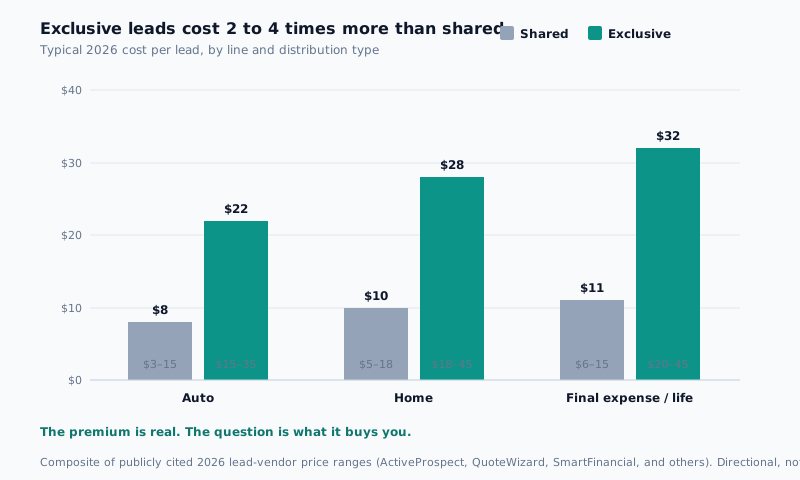
The premium is consistent: exclusive runs two to four times the price of shared. The useful question is not whether it is "worth it" but what it replaces, and whether you can replace it more cheaply yourself.
The math that actually decides it
Cost-per-lead is a vanity number. The figure that pays your bills is cost-per-bind: what you spend in lead dollars for every policy that closes. As we covered in the aged-lead cost-per-bind math, the cheap number and the expensive number routinely meet in the middle once you divide. Take two agencies buying the same auto prospect:
- Exclusive: $30 per lead, closes at 15 percent. Cost-per-bind: $200.
- Shared: $10 per lead, closes at 5 percent. Cost-per-bind: $200.
Identical. Exclusive gets there with far less dialing per bind; shared costs a third as much but burns more dials and producer time for the same policy. Neither is "winning" on cost. They reach the same price by different routes.
So the decision is not "which lead type is better." It is "which side of that equation can I move?" And one lever moves the shared side hard enough to make it win: speed.
Why shared leads live or die on speed
When a lead is shared with five agencies, close rate is not really about your script. It is about whether you are the agency the prospect actually talks to, and they will have one conversation, maybe two, before they stop answering unknown numbers.
The response-time research is some of the most replicated in sales, and we walked through it in the speed-to-lead post: calling a web lead inside the first minute produces a several-hundred-percent lift in contact rate, and the firm that responds first wins most of the business because it is often the only firm the prospect speaks to. On a shared lead, that is the entire game. The agency that reliably calls first in seconds treats shared leads almost like exclusives, getting there before the other four wake up, at a third of the price.
That is also the honest reason exclusive leads are so popular: they forgive slowness. Exclusive is, in effect, a way to buy your way out of a speed problem you cannot fix by trying harder, because a producer cannot answer a lead in sixty seconds while they are on another call, at lunch, or asleep, and a shared lead that lands at 7pm is raced by other agencies' automation while your team is at dinner (the after-hours problem). So agencies pay the premium to opt out of a race they keep losing. That is legitimate, and expensive, and in 2026 no longer the only way to stop losing.
Where Entrovox fits
Entrovox was built around the exact gap that makes shared leads risky: being first, on every lead, at every hour. Close that gap and the cheaper lead type starts winning on cost-per-bind.
- The first call goes out in seconds. The moment a lead hits your system, from any vendor or web form, an AI voice agent calls, day or night, weekends too. On a shared lead, that is the difference between the conversation and a no-answer, so you become the agency the prospect talks to.
- It qualifies, then warm-transfers a live human. The AI confirms the prospect is real, interested, and a fit, then hands the call to your producer with a one-page Transfer Context Card on screen. Producers spend their time closing the shared leads you won, not dialing voicemail on the ones you lost.
- Branded, trusted caller ID. A win only counts if the prospect picks up. Branded caller ID and STIR/SHAKEN attestation with number rotation keep your dial from landing as "Spam Likely" while a competitor's does (the spam-likely problem).
- Speed plus cadence, automatically. If the first call misses, the full multi-touch follow-up cadence runs on its own, with the 8am-to-9pm window, DNC scrubbing, and state mini-TCPA overlays enforced on every call (the TCPA guide).
The economics are blunt. If instant first contact lets you close shared leads at the rate you currently need exclusives to hit, you buy the same binds for a third to a half of the lead spend. You did not find better leads. You stopped losing the race on the cheap ones.
So which should you buy?
It comes down to one thing: your real first-response time. If you cannot yet make the first call within a minute on every lead, nights and weekends included, buy exclusive for now. You are paying the premium to opt out of a speed race you would lose. If you can call instantly on every lead, shared usually wins on cost-per-bind, because you capture the same conversations at a fraction of the price.
Either way, stop judging leads by cost-per-lead and track cost-per-bind by source over a 90-day window (bind rate benchmarks). Run shared and exclusive side by side, divide lead spend by binds, and let the number decide. Most owners are surprised which wins once speed is no longer the variable they are quietly losing on.
Shared leads only win if you win the first dial. That job is scored on AI voice agent for insurance agencies.
Want to see a sub-minute first call run on one of your own shared leads, qualification and warm transfer included? Book a 20-minute demo and we will run a live test.