How to Get More Referrals for Your Insurance Agency (2026)
Referred clients bind faster, stay longer, and cost almost nothing — so why do most insurance agencies get so few? The 2026 referral engine playbook, minus the gimmicks.
The short answer
The best leads your agency will ever work do not come from a vendor. They come from the clients you already have, and they cost almost nothing. Referred prospects arrive pre-trusted, bind at far higher rates, and stay longer than anyone you buy. Yet most agencies get a trickle of them, not because clients are unwilling but because no one ever asks in a consistent, deliberate way.
The fix is not charm or a bigger gift card. It is a system: ask at the moments a client is happiest, make referring take ten seconds, and call the name you get back fast, while the introduction is still warm.
Why referrals are the highest-ROI "lead source" you have
Every other lead you work has to earn trust from zero. A referral starts with trust already in the bank. When a friend, coworker, or family member says "call my agent, they're great," your prospect is not comparison-shopping four quotes and dodging unknown numbers. They are ready to talk.
The numbers back up what every veteran producer already feels:
- Referrals are the most trusted form of advertising there is. Nielsen's long-running trust research consistently finds that recommendations from people you know beat every paid channel by a wide margin. No ad you can buy carries that weight.
- They convert far better. Marketing studies routinely find referral leads convert several times higher than other channels — a different league from the low single-digit bind rates on shared internet leads.
- They stay longer and are worth more. A Wharton-led study that tracked nearly 10,000 customers over 33 months found referred customers were about 18% less likely to defect and worth roughly 16–25% more in lifetime value than customers acquired other ways. In an insurance book, where profit lives in years two, three, and four, a stickier client is worth far more than the first-year commission suggests.
Put those together and a referral is not merely a cheaper lead than the ones you buy. It is a better one on every axis that matters: it closes more often, at lower cost, and it lasts.
The real reason you don't get more: the 83% problem
Here is the uncomfortable part. Your clients are not withholding referrals. They are just never asked.
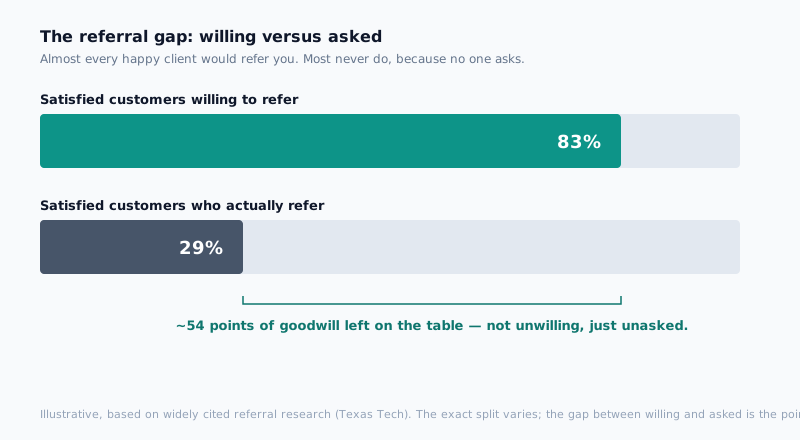
Widely cited research from Texas Tech found that about 83% of satisfied customers are willing to refer, but only about 29% ever do. That is not a small leak. It means for every client actively sending you business, roughly two more would happily do it and simply have not been prompted.
And it makes sense. A happy insurance client thinks about their policy for maybe fifteen minutes a year. The rest of the time, your product does its job by being invisible. That invisibility is exactly what you want in coverage, but it is death for word of mouth, because the moment to mention you to a friend passes without a trigger. The willingness is real; the reminder is missing.
Which is the good news, actually. A problem of "nobody asked" is far easier to fix than a problem of "clients don't like us." You do not need to become more likeable. You need to become more deliberate.
Where agencies leak referrals
Most referral programs die in one of three ways. Fix these and you have already beaten the field.
They ask once, or never. A poster in the lobby and a line in the email footer is not a program. The ask has to happen at a human moment, out loud or in a real conversation, and it has to happen every time — not when a producer remembers.
They ask at the wrong time. Cornering a client for names when they just called with a billing problem feels transactional and gets nothing. The ask lands when the client has just been reminded, concretely, that you are on their side.
They make it a chore. "Send anyone my way" puts all the work on the client, so nothing happens. "Is there one person in your life who just bought a house or had a kid and might be overpaying? I'll take great care of them, same as I did for you" gives them one easy, specific action.
The moments that actually produce referrals
You do not need more clients to ask. You need to ask your current ones at the points where goodwill peaks:
- Right after onboarding. A new client who just had a smooth welcome call is at peak enthusiasm. This is the single best moment, and almost nobody uses it.
- After a good claim. Nothing proves your value like being there when something went wrong and making it painless. Ask a week later, once the relief has set in.
- At a clean renewal. A renewal conversation where you saved them money — or simply handled it without drama in a shop-happy market — is a natural, earned moment to ask.
- After you catch something proactively. You spotted a coverage gap, rounded out an account, flagged an X-date. You just demonstrated you are paying attention. Ask.
Notice these are the same touchpoints that drive retention. A referral engine and a retention engine are the same machine pointed at the same happy moments — which is also why the referral ask pairs naturally with a Google review ask. One good conversation can do both.
Where Entrovox fits
A referral engine has two failure points, and both are about consistency at the phone.
The first is the ask that never happens. The moments above only produce referrals if someone actually reaches out at each one — after every onboarding, every renewal, every claim resolution — and asks. That is exactly the kind of mechanical, easy-to-skip, do-it-every-single-time work that gets dropped the instant a producer's day gets busy. Entrovox runs those outbound touches automatically. The AI voice agent can place the welcome call, the renewal check-in, and the post-claim follow-up, deliver the review-and-referral ask in a natural conversation, and capture any name the client offers — so the ask happens on 100% of clients instead of the handful a producer gets to. Nobody has to remember, and nothing gets skipped on a busy Tuesday.
The second is the referral that goes cold. When a client does hand over a name, that referral is a warm lead — and warm leads decay just like any other. The prospect is feeling good about it now and getting less receptive by the hour, so the same speed-to-lead math that governs internet leads governs referrals: reach them while the introduction is fresh. One caveat worth naming, because it is easy to get wrong: a name a client mentions on a call does not carry the written consent a web-form lead does, so a fast first touch has to be a compliant one. Entrovox runs every referral through the same gates as any other call — it confirms a valid consent basis, scrubs against DNC, and honors the local calling window before it ever dials — and only then places a prompt call, confirms interest, and warm-transfers a live person to your producer. Fast and compliant are not a tradeoff; the TCPA rules apply to a referral exactly as they do to a purchased lead, and the system enforces them so a referral your client worked to give you neither dies in a callback queue nor turns into a compliance problem. The same six-attempt cadence and Spam Likely problems apply here as they do on purchased internet leads — that scorecard lives on AI voice agent for insurance agencies.
You already have the clients. You already have the goodwill. What most agencies lack is a reliable way to convert both into conversations, at every happy moment, without adding it to a producer's already-full plate. That is the gap this closes.
What to do this week
You do not need a platform to start. Pick one moment — new-client onboarding is the highest-yield — and add a single, specific ask to it. Script it so it is one easy action for the client, not an open-ended favor. Track two numbers: how many asks you made and how many names came back. Most agencies have never measured either, and the act of counting is usually enough to reveal how few asks are actually happening.
Then close the loop that matters most: whatever your source, the moment a referral's name lands, call it fast. A warm introduction left sitting for two days is a cold lead with extra steps.
Referrals are not luck, and they are not a gift you either have or don't. They are the predictable output of asking the right people at the right time and following up before the moment passes. The agencies that treat that as a system, not a hope, quietly build the cheapest and best book of business in their market.
Want to see the welcome call, the review-and-referral ask, and an instant call-back on a live referral run end to end? Book a 20-minute demo and we'll walk one of your own moments through it.