Insurance Client Retention in 2026: The Renewal Call Playbook for a Shop-Happy Market
More than half of auto customers shopped their policy last year. Here is the 2026 math on why keeping a client beats winning one, and a simple renewal-call playbook for insurance agencies.
You can't out-sell a leaky bucket
Every agency owner knows the feeling: you write a strong month of new business, then look up a quarter later and the book is the same size. The new policies came in the front door while just as many quietly walked out the back at renewal. That's a retention problem wearing a sales costume, and you can't fix it by selling harder.
Here's the part that stings. The clients leaving are the cheapest, most profitable business you'll ever have. And in 2026, more of them are heading for the door than at any point in recent memory.
The market turned your clients into shoppers
The hard market did something to your book you can't undo by ignoring it. Auto premiums climbed to a record average of about $2,543, up 26 percent in a single year, and that pain put every renewal letter in play.
The result: 57 percent of auto-insurance customers shopped their policy in the past year, the highest rate in the 19 years J.D. Power has tracked it, up from 49 percent the year before. Switching hit an all-time high. J.D. Power named rate pressure and customer retention the top two industry challenges heading into 2026.
Translation: your renewing clients are not loyal by default anymore. Half of them are already curious what the agency down the street would charge. The only question is whether they hear from you first, or from a competitor's ad.
Why losing a client costs more than you think
When a client leaves, you don't just lose their premium. You lose the cheapest revenue in your business and then pay a premium to replace it.
In insurance specifically, winning a new customer costs roughly seven to nine times more than keeping an existing one, well past the well-worn "5x" rule of thumb. So every client who lapses forces you to spend seven-to-nine-times dollars buying a stranger just to tread water.
Flip it around and the upside is just as steep. Bain's research found that lifting retention by 5 percent can raise profit by more than 25 percent in financial services, because retained clients renew, buy more lines, and refer, all without new acquisition cost. Small retention gains compound. New business alone doesn't.
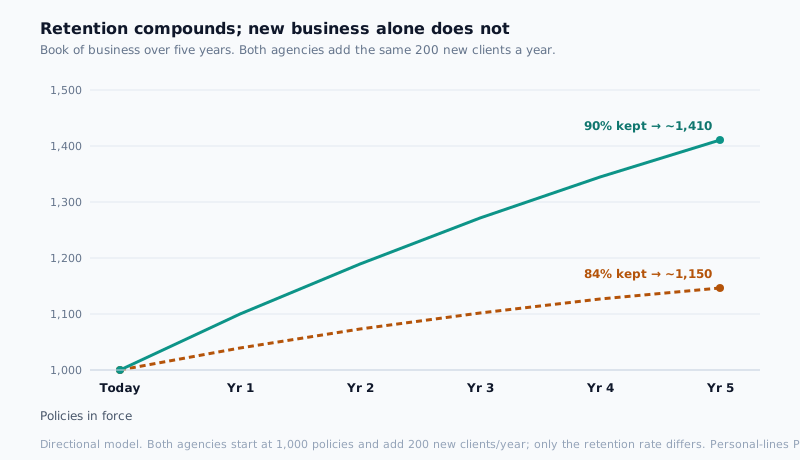
That chart is the whole argument. Two agencies, same new-business effort, six points of retention apart. After five years one book is nearly a quarter larger, and it got there without writing a single extra policy.
The renewal call is the cheapest retention you own
So what actually keeps clients? Not a louder ad budget. The single most reliable retention move is unglamorous: talk to the client before their renewal, not after.
A client who gets a surprise rate increase in the mail, with no warning and no human attached, feels like a line item. They shop out of resentment. The same client who got a friendly call a few weeks earlier, "hey, your renewal's coming up, premiums are up across the board this year, here's what we're seeing and here's what we can do," feels handled. They stay, even when the number went up.
The call doesn't have to save every dollar. It has to beat them to the moment of doubt. Being first is most of the win.
A renewal cadence that actually works
You don't need a complicated playbook. Three touches around each renewal covers the vast majority of saves:
- 60 to 75 days out: a proactive check-in. Anything change this year, new car, teen driver, home improvement? This is also your natural cross-sell and account-rounding opening, and multi-line clients churn far less.
- When the renewal premium is set: if there's a meaningful increase, get ahead of the letter. Explain it like a human, present options, and you've defused the shopping reflex before it fires.
- Just after renewal: a quick confirmation and thank-you. Cheap, rare, and it makes the next renewal easier.
That's it. The agencies that retain best aren't smarter; they're just consistently the first voice their clients hear at renewal.
The catch: nobody has time to make these calls
Here's why most agencies don't run this cadence even though they know it works. Do the math on a 1,500-client book. That's 1,500 renewals a year, three touches each, 4,500 outbound calls, most landing in voicemail. Your producers are paid to close new business and put out fires, not to dial through a renewal list that mostly doesn't pick up.
So the renewal call is the first thing that falls off the calendar in any busy week, which is most weeks. The retention everyone agrees is valuable simply never gets staffed. The clients lapse quietly, and the book treads water.
Where Entrovox fits
This is exactly the kind of high-volume, time-sensitive outreach that breaks when you staff it by hand and works beautifully when you don't. Entrovox is an AI voice agent built for insurance outbound, and renewal retention is a natural fit.
- It works the whole renewing book on schedule. Every client gets the 60-day check-in call, automatically, whether you have 300 renewals this month or 3,000. No list falls off the calendar.
- It flags the flight risks. When a client sounds rate-sensitive or mentions they've been shopping, the agent surfaces it so a producer can step in on the accounts that actually need a human save.
- It warm-transfers the saves. A client who wants to talk options gets handed live to a licensed producer with a one-line summary, the same warm-handoff that binds new leads, pointed at keeping the ones you have.
- It frees producers for the work only they can do. The AI absorbs the dialing and the voicemails; your people spend their hours on conversations that close and save.
And yes, today's voice agents sound human, and the same TCPA calling rules you already follow apply to retention calls too.
What to do this week
Pull your retention rate for the last 12 months. If you don't have it, that's the first finding. Then list every client renewing in the next 90 days and ask one question: who has actually heard from us about it? For most agencies, the honest answer is "almost no one," and that gap is the cheapest growth on the table.
Renewal calling uses the same muscle as purchased-lead outbound. That scorecard is AI voice agent for insurance agencies.
Want your renewing book called on schedule, flight risks flagged, and the saves warm-transferred to your team? Book a 20-minute demo and we'll run it against your real renewal list.