Do AI Voice Agents Actually Sound Human? What Insurance Agency Owners Need to Know (2026)
The biggest fear about AI calling is that prospects will hate talking to a robot. Here is what 2026 voice AI actually sounds like, whether people can tell, and what the law says about disclosure.
The fear every agency owner says out loud
When we talk to agency owners about AI calling, the objection is almost always the same, and it usually comes before the pricing question: "My prospects are going to hate talking to a robot." Right behind it: "Won't it sound fake?" and "Is it even legal to call people with a bot?"
These are good questions. For most of the last decade, the honest answer to "will it sound like a robot" was yes, obviously. The flat text-to-speech voice, the two-second pause before every reply, the way it talked right over you when you tried to interrupt. Everyone has hung up on that call. If that is your mental picture of AI calling, the skepticism is earned.
The picture is just out of date. Here is what actually changed, what the research says about whether people can tell, and what the law requires you to say.
Why 2026 voice AI doesn't sound like the old robocall
Three specific things make the difference between "obviously a machine" and "wait, was that a person?"
Response timing. Natural human conversation is fast. When researchers measured turn-taking across cultures, they found the gap between one person finishing and the next person starting averages about 200 milliseconds — so quick that we actually predict when the other person will stop and start planning our reply before they do. The old robocall left a dead two-to-three-second pause that screamed "computer thinking." Modern voice stacks respond inside roughly that human window, and in the industry, sub-300-millisecond response is now considered table stakes. That single change is most of why a call feels human or not.
Interruption handling. Real people interrupt each other. You start to answer, change your mind, talk over the end of a question. A natural-sounding agent does what a person does: the moment you start talking, it stops and listens, then picks back up. The clunky systems plowed ahead through your interruption. This is called barge-in, and it is the difference between a conversation and a recording.
The voice itself. Synthesized voices now carry intonation, breaths, and natural pacing instead of the robotic, evenly-stressed cadence of old text-to-speech. They emphasize the right word in a sentence. They sound like someone who is paying attention.
The uncomfortable part: people usually can't tell
This is where it gets genuinely surprising. People are confident they can spot an AI voice. They mostly cannot.
In a 2025 Twilio consumer survey, 72 percent of people said they could identify an AI voice in an interaction — and then 90 percent failed to correctly pick out the AI-generated voice clip when they were actually tested. The age group that did best, Gen X, got it right only about 14 percent of the time. Academic research backs this up: a 2025 study from Queen Mary University of London found listeners correctly flagged a modern synthetic voice as AI only about 60 percent of the time, barely better than guessing.
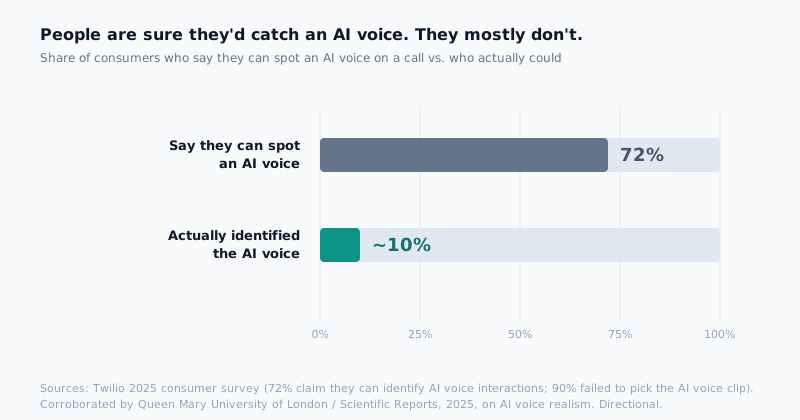
The reason this matters for your agency: the realism is no longer the bottleneck. If you have been holding off on AI calling because you assumed prospects would instantly recoil, that assumption is outdated. They very often won't notice — which raises a more interesting question than "can it pass?"
"Can't tell" isn't the goal — and shouldn't be
Here is the part most AI vendors skip. In that same research, 69 percent of consumers still said they prefer speaking with a human. People not being able to detect AI and people wanting AI are two different things.
So the goal is not to fool anyone into thinking a machine is a person. That is a short-term win that turns into a long-term trust problem the moment a prospect realizes they were deceived — and in insurance, where the entire relationship runs on trust, that is a terrible trade. The goal is to use AI for the part humans are genuinely bad at, and hand off the part humans are best at.
No producer can call every lead within a minute, at every hour, including the after-hours leads that arrive when the office is dark. That is mechanical, time-critical work — exactly what AI should do. Closing a warm, interested prospect over the phone is human work. The right design lets the AI place the instant first call, confirm the prospect is real and interested, and then warm-transfer a live human caller to your producer. The prospect spends their human conversation with your team, not stuck in a queue. The AI did the dialing nobody had time for; the producer does the closing.
Do you have to disclose that it's AI?
Increasingly, yes — and you should want to.
California's B.O.T. Act (SB 1001), in effect since 2019, makes it unlawful to use a bot to mislead someone about its artificial identity in order to incentivize a sale. Utah's Artificial Intelligence Policy Act, with amendments effective May 2025, requires businesses to disclose AI use when a consumer asks directly, and proactively in certain regulated-transaction settings. California's SB 243 took effect January 1, 2026, and while it targets companion chatbots specifically, it is one more signal of where every state is heading: if a reasonable person could be misled into thinking they are talking to a human, you disclose.
The practical takeaway is simpler than the legal patchwork. Disclose by default. A natural, friendly "Hi, this is an automated assistant from {your agency} — I can get you a quick quote or connect you with a licensed agent" costs you almost nothing and removes the only real reputational landmine. People do not mind an AI that is upfront. They mind being tricked.
Disclosure is separate from the other compliance rule that trips agencies up: recording. Two-party-consent states (California, Florida, Illinois, Washington, and others) require you to disclose that a call is being recorded. That is a distinct obligation from AI disclosure, and a well-built platform handles it automatically based on the prospect's state. The full calling-compliance picture lives in our TCPA guide for 2026.
Where Entrovox fits
Entrovox was built around exactly this balance — sound human enough to have a real conversation, be honest about what it is, and hand the prospect to a person fast.
- Natural, low-latency conversation. The agent responds inside the human turn-taking window and supports barge-in, so prospects can interrupt and it yields immediately. Telephony-tuned noise cancellation and turn detection keep it composed on real-world phone lines, accents and cross-talk included.
- Honest by design. The agent identifies itself as an automated assistant. You are not gambling your agency's reputation on a prospect never finding out.
- Recording disclosure handled automatically. For two-party-consent states, the agent speaks the recording-consent line on its first turn and respects a "no." It is a per-lead-source setting, so your compliance posture is configured once, not improvised call by call.
- Warm transfer to your producer. When a prospect is qualified and interested, Entrovox hands off the live call to a human, with a one-page context card on screen so the producer picks up mid-conversation already knowing who they are talking to. The prospect gets their human; the producer skips the dialing.
- Speed no human team can match. The first call goes out within seconds of the lead landing, day or night — the speed-to-lead edge that decides who binds, applied to every lead instead of the ones someone happened to catch.
What to do this week
Two low-effort moves settle the question better than any more reading. First, listen to a real AI call before you judge from memory — your mental model is probably the 2015 robocall, not a 2026 agent, and the two are not the same product. Second, decide your disclosure line now, in plain language, before you ever turn anything on. If you can say it out loud and it feels honest, you have cleared the only bar that actually matters with prospects.
The robot-voice objection was the right instinct three years ago. In 2026 the question is no longer "will it sound fake." It is "will I use it honestly, and hand the warm prospect to a human fast enough." Get those two right and the technology is no longer the hard part.
Sounding human is table stakes. The jobs that decide whether purchased leads bind are on AI voice agent for insurance agencies.
Want to hear what a natural, upfront AI call actually sounds like on one of your own leads — qualification, recording disclosure, and a warm transfer to your producer included? Book a 20-minute demo and we'll run a live one.