TCPA Compliance for Insurance Agencies in 2026: The One-to-One Consent Rule Is Dead
The FCC's one-to-one consent rule was struck down in 2025. Here's what TCPA compliance actually requires for P&C insurance agencies dialing leads in 2026 — and what didn't change.
The question every agency owner is quietly nervous about
You buy thousands of leads a month and your team dials them. Somewhere in the back of your mind sits a number you would rather not think about: 500 dollars per call — the floor for a TCPA violation, and 1,500 dollars if a court decides you did it knowingly. Multiply that across a class of a few thousand consumers and you see why TCPA is the one acronym that can end an agency.
The good news for 2026: the rules are clearer than they've been in years, and the scariest proposed change never took effect. The bad news: most of what owners think they know about consent is out of date.
What changed in 2025: the one-to-one rule is dead
For most of 2024, the lead-generation world braced for the FCC's "one-to-one consent" rule. A consumer filling out a quote form would have had to consent to each company separately, and calls had to be "logically and topically related" to that form. For an agency buying shared leads, it was a nightmare scenario: every vendor's consent language would have had to name your agency, one at a time.
It never happened. On January 24, 2025, days before the rule was due to take effect, the Eleventh Circuit struck it down in Insurance Marketing Coalition v. FCC. The court held the FCC had overstepped: the statute says "prior express consent," and under common-law meaning a consumer can clearly agree to calls from several companies at once.
Translation: a single clear consent on a lead form can still cover you, even when that lead is sold to four other agencies at the same moment. You do not need a separate agreement naming your shop alone.
What did not change (this is where agencies get burned)
Here is the trap. "One-to-one is dead" gets repeated until it mutates into "consent doesn't matter." That's wrong — and it's the belief most likely to land you in court.
Striking down the one-to-one rule did not touch a far older requirement: telemarketing calls placed with an autodialer or an artificial or prerecorded voice to a cell phone need prior express written consent. Most internet leads are cell numbers. So you still need a signed (e-signature counts) agreement on the form, a clear and conspicuous disclosure, and the seller identified. The vacated rule just means one disclosure can name a category of partners instead of you alone.
Vacating one-to-one made consent easier to satisfy. It did not make it optional.
The four gates every dial has to pass
Strip away the headlines and the daily rules are stable: every outbound dial has to clear four gates.
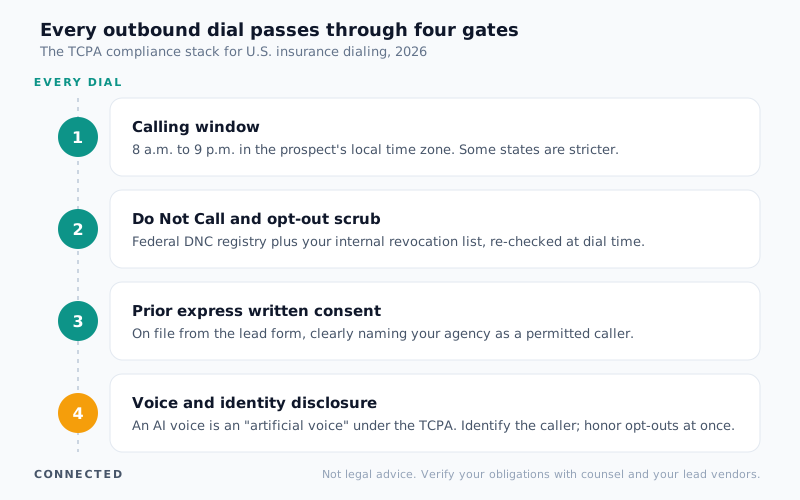
1. The calling window. Solicitations are limited to 8 a.m. through 9 p.m. in the called party's local time zone, not yours. Several states (Florida, Oklahoma, Washington) add stricter limits. Because an area code does not always match where someone lives, enforce the window by the prospect's actual zone.
2. Do Not Call and opt-out scrub. Scrub the federal DNC registry and your own opt-out list at dial time, not once a month. A number that opted out last Tuesday must be dead by this Tuesday.
3. Prior express written consent. Covered above — and keep the record: in a dispute, the burden of proof is on you, not the consumer.
4. Voice and identity disclosure. Say who is calling and offer a clear way to opt out on the call itself.
Yes, AI voice agents are covered — that's the point
In February 2024 the FCC settled the debate: AI-generated voices are "artificial or prerecorded voices" under the TCPA — held to the same standard as any other artificial-voice call.
Read carefully, that is reassuring. AI calling is not a gray zone you are sneaking into; it sits inside rules that have existed for a decade. The risk was never the technology — it was always whether the dialing respects consent, the window, and opt-outs. Those are exactly the things software enforces better than a room of producers under quota.
The 2025 revocation rule drives it home. Consumers can now revoke by "any reasonable means" — "stop calling me" on a call counts — and you must honor it within ten business days. As of April 2026 that opt-out must propagate across all your campaigns, not just one. A "DNC" on a sticky note does not scale to that; a system that logs the request the instant it is spoken does.
Where Entrovox fits
Compliance is not a feature you bolt on; it's the rail the platform runs on. Every Entrovox call clears the four gates before a human picks up:
- Calling-window enforcement. Calls fire only inside the allowed window for the prospect's own time zone, configurable per state. After-hours leads queue and dial when the local 8 a.m. window opens.
- Scrub at dial time. Federal DNC and your internal opt-out list are checked on every dial, never in a nightly batch.
- Consent on the record. The lead's consent snapshot travels with the record, so the proof is attached if you ever need it.
- Revocation captured live. When a prospect asks to stop, the AI suppresses the number in real time and propagates it across campaigns.
- Clean caller identity. Branded caller ID and STIR/SHAKEN A attestation announce who you are — which also lifts answer rates, as we covered in our Spam Likely post.
Entrovox does not replace your compliance officer. It removes the manual steps where compliance breaks: the late dial, the missed opt-out, the lead nobody scrubbed.
Your 20-minute compliance check this week
You do not need a new platform to close the obvious leaks today:
- Time-zone check. Pull 50 recent dials. How many landed outside 8 a.m. to 9 p.m. in the prospect's zone? Any at all is a problem.
- Opt-out latency. When someone says stop, how long until they are suppressed everywhere? If the answer is "end of week," shorten it.
- Consent proof. Pick one lead vendor. Can you produce the exact consent language and timestamp for one lead in under five minutes? If not, fix record-keeping first.
None of it costs money, and all of it lowers the odds of the 500-dollar-per-call letter nobody wants to open. The agencies that win in 2026 are not gambling they won't get caught — they treat compliance as plumbing, automatic and logged, so producers can focus on the only thing that pays: the binding conversation.
TCPA, DNC, and 50-state calling hours are non-negotiable on every attempt. They sit on the AI voice agent for insurance agencies scorecard.
Want a compliant 60-second AI dial on one of your own leads? Book a 20-minute demo and we'll place a live test call.