Call Recording Consent Laws for Insurance Agencies (2026): The Rule That Follows the Lead, Not You
You record every sales call for QA and disputes. But recording consent law isn't TCPA — it's set by the lead's state, and a dozen states require everyone to agree. Here's the 2026 map.
The gate most agencies forget they have to clear
You record your sales calls. Almost every agency does, for good reasons: training producers, settling "I never agreed to that" disputes, defending an E&O claim, and now feeding AI that scores and summarizes them.
Here's the part that trips people up. The law that governs whether you can place the call isn't the same law that governs whether you can record it. The first is TCPA. The second is a separate stack of wiretap statutes — and unlike TCPA's nationwide floor, recording consent is set state by state, by the lead's location, not yours.
If you buy leads across the country and dial them from one office, you're quietly making that recording decision dozens of times a day under a dozen different rulebooks.
One-party vs all-party: the two regimes
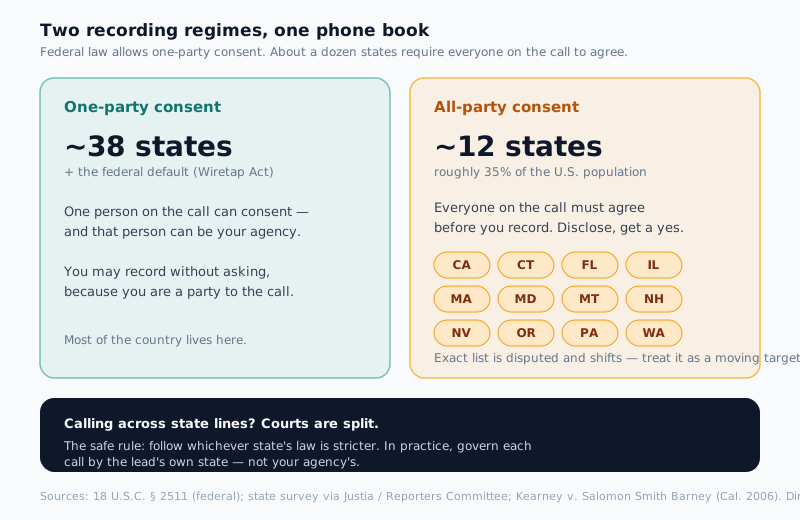
Federal law sets a one-party-consent floor. Under the Wiretap Act, you can record a call you are part of, because you are one of the parties and you consent. Most states follow the same rule, and there recording your own sales calls needs no announcement at all.
Then there are the holdouts. Roughly a dozen states require all-party consent: everyone on the line has to agree before you record. The exact roster is genuinely disputed — sources count 11, 12, or 13, depending on how they treat states that split in-person from phone — but the names that show up over and over are California, Connecticut, Florida, Illinois, Maryland, Massachusetts, Montana, Nevada, New Hampshire, Oregon, Pennsylvania, and Washington. That's about 35% of the U.S. population, including some of the biggest insurance markets.
The trap: it follows the lead, not the office
Most owners, if they think about this at all, check their home state once and move on. "We're in Texas, Texas is one-party, we're fine." That instinct is exactly the mistake.
When a call crosses state lines — your Texas producer dialing a California lead — there's no tidy federal answer about which law wins, and courts have split. The rule that has emerged is to follow whichever state's law is stricter. California's Supreme Court took the most aggressive version in Kearney v. Salomon Smith Barney, holding that California's all-party requirement applied to a firm recording from a one-party state, simply because the consumer was in California.
So you can't run your recording policy off your own zip code. Govern each call by the lead's state — a California lead gets California's treatment even though nobody in your building lives there.
What lawful consent actually sounds like
In an all-party state, consent isn't a checkbox buried in a lead form — it's something the person on the call agrees to, up front. The disclosure comes in the first breath of the call, before the real conversation, and you get a clear yes:
"Quick heads-up, this call is being recorded — is that okay?"
If they say no, you stop recording and either continue without it or end the call. Disclose late, after you've already captured the substance, and it does little for you. Keep the consent on the record, too — in a dispute the burden of showing you had it falls on you.
The cost of getting this wrong isn't theoretical. Federal violations are a felony — up to five years and civil damages of at least $10,000 — and states pile on. California alone allows statutory damages of up to $5,000 per recorded call, or three times actual damages. Multiply that across an improperly recorded book and you have a class-action shape of problem — the same shape that makes TCPA so dangerous.
Why this is miserable to do by hand
No producer working a list reliably checks each lead's state and whether it's one-party or all-party this year before they start talking. The same script comes out on the Nevada lead as the Nebraska one. So agencies pick a bad default: announce on every call (annoying the 80% who don't need it) or never announce (and break the law on the California, Florida, and Illinois leads).
Where Entrovox fits
This is the kind of rule software should enforce so a human never has to remember it. Entrovox handles recording disclosure per call, keyed to the lead's own state:
- It knows the lead's state and the regime that goes with it. Before each call, Entrovox checks whether the lead sits in an all-party state. In those states the AI agent ends its first utterance with the recording-consent question; in one-party states it skips the announcement, so you don't add friction where the law doesn't ask for it.
- A "no" is honored automatically. If the lead declines, the agent acknowledges it, doesn't record, and continues. The consent — or the refusal — travels with the call record.
- It's configurable per lead source. Recording disclosure is a per-source toggle (on by default), so you can match how a given vendor's leads were collected.
- It rides on the same compliance rail as everything else — alongside calling-window enforcement, real-time DNC and opt-out scrubbing, and branded caller ID, the four gates from the TCPA guide. Compliance is the rail, not a feature bolted on after.
Entrovox doesn't replace your counsel. It removes the step where this rule breaks: the human who can't track 50 states' recording laws while dialing a list, and defaults to getting it wrong half the time.
Your 15-minute recording check this week
You don't need to change platforms to find your exposure today:
- Map your lead states against the all-party list. Pull last month's leads by state. How many came from California, Florida, Illinois, Washington, or the others above? That's the slice of your book exposed if you record without disclosure.
- Listen to five calls into an all-party state. Is the recording disclosed in the first few seconds, with a clear yes? Or not at all? Your answer tells you whether you have a problem.
- Decide your default on purpose. "Announce on every call" and "never announce" both sound defensible and are both wrong. The right policy keys off the lead's state — and if a human can't execute that, it belongs in software.
Recording your calls is one of the smartest things an agency does. Recording them the same way in all 50 states is one of the quietest risks it carries. The fix isn't to record less — it's to make the disclosure follow the lead.
Recording disclosure is part of the same 50-state stack as TCPA and DNC on the AI voice agent for insurance agencies scorecard.
Want to hear a state-aware recording disclosure run on one of your own leads? Book a 20-minute demo and we'll place a live test call.