Should You Leave a Voicemail for Insurance Leads? (2026)
Voicemails to insurance leads rarely get a callback and can actually lower your future connect rate. Here is what the data says, the TCPA catch, and what to do instead.
The voicemail you almost left
A new auto lead comes in. You dial. It rings four times and rolls to voicemail. Your thumb hovers. Do you leave a message and move on, or hang up and try again later?
Most agencies leave the message. It feels productive, it feels polite, and it checks the "I followed up" box. But the data on what voicemails actually do is uncomfortable, and for an insurance lead in particular, the reflex is usually the wrong move.
What the data actually says
Start with the callback rate. Across sales teams, fewer than 5 percent of voicemails get returned. That is the optimistic number, for messages left by people the prospect was at least somewhat expecting to hear from.
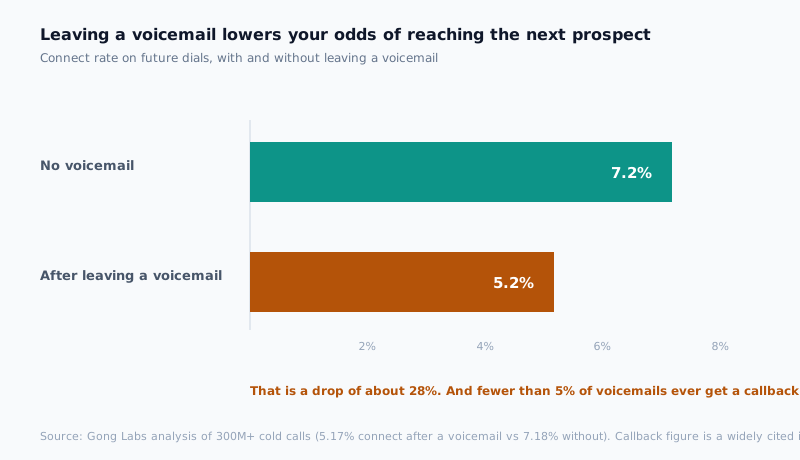
It gets worse. Gong Labs analyzed more than 300 million recorded cold calls and looked at what happened after a rep left a voicemail. Leaving one dropped the rep's connect rate on future dials from about 7.2 percent to 5.2 percent, a decline of roughly 28 percent. The likely reason is simple: a voicemail tells the prospect a salesperson is chasing them, so they start screening your number.
Why this hits insurance leads especially hard
A cold B2B prospect did not ask to hear from you. An insurance lead did. Someone who just submitted a quote form is a buyer in motion, often filling out three or four forms in one sitting and waiting for a phone to ring. That changes the math in two ways.
First, the clock is brutal. Whoever connects live first usually wins, which is the whole point of the 5-minute speed-to-lead rule. A voicemail is the opposite of speed. It parks the conversation and hopes the buyer circles back, while a competitor who picked up is already quoting.
Second, you paid for this lead. When you drop a voicemail on a shared or exclusive lead and wait, you are spending real money to start a conversation and then handing the timing to a distracted prospect. The follow-up problem is the same one behind every lead that gets quoted but never bound: the message goes out, nothing comes back, and the lead quietly goes cold.
The one time a voicemail earns its keep
Voicemails are not useless. They are just misunderstood. The same Gong research found a silver lining: leaving one or two voicemails roughly doubled the prospect's email reply rate when each message was paired with an email.
So the job of a voicemail is not "call me back." It is "go check your inbox." A ten-second message that says you just sent a quick note about their quote, followed immediately by that text or email, beats a thirty-second pitch that ends with your number. The ceiling is one or two messages across the whole lead, not a fresh voicemail on every dial.
The TCPA trap with voicemail drops
Tempted to automate this with a bulk voicemail-drop or "ringless voicemail" tool? Read this first.
In November 2022 the FCC ruled that ringless voicemail is a "call" made with a prerecorded or artificial voice, which puts it squarely under the TCPA. In plain terms, dropping voicemails into a prospect's inbox without their prior express consent can carry the same legal exposure as an illegal robocall, and TCPA damages run from $500 to $1,500 per message.
What actually works better
If a voicemail is rarely the answer, what is? Three things, in order.
- Call faster, so fewer dials ever reach voicemail. The earlier you call, the more likely a person is still by their phone with the quote on their mind. Most voicemails are a symptom of calling too late.
- Double-dial before you give up. A quick second call often gets answered when the first did not. One frequently cited test found answer rates jumped from 16 percent to 60 percent on the second attempt, and almost no one was annoyed by it. It is a small sample, so treat it as directional, but the pattern lines up with everything we know about how many attempts it takes to reach a lead.
- Pair a short text with a brief voicemail, not a voicemail alone. If you are going to leave a message, make it the nudge that gets your email or text opened.
Where Entrovox fits
Here is the quiet truth about voicemails: most of them exist because a human could not get to the lead in time. Close that gap and the voicemail problem mostly disappears.
- Far fewer dials reach voicemail in the first place. Entrovox calls every new lead within about 60 seconds, in a natural voice, so the conversation happens live while the buyer is still warm instead of rolling to a message no one returns.
- It retries the way a disciplined producer would. Missed the first dial? Entrovox follows a smart cadence with a quick second attempt and spaced follow-ups, instead of leaving a callback message and waiting on a 5 percent return rate.
- It stays inside the rules. Calls run within TCPA, DNC, and state calling-hour requirements, with branded caller ID so your number is less likely to get flagged as "spam likely." No legally risky ringless-voicemail shortcuts.
- Your producers stop leaving messages all day. Reps who would otherwise burn hours leaving voicemails almost no one returns get handed warm, qualified prospects with a one-line summary. The AI does the dialing and waiting; licensed humans do the quoting and closing.
What to do this week
You do not need new software to test this. Pick your next batch of fresh leads and split it:
- On half, leave your normal voicemail on the first miss.
- On the other half, leave no message, and instead double-dial a few minutes later and send a one-line text.
Track which half you actually talk to over the next 48 hours. For most agencies, the no-voicemail, fast-follow-up group wins, and it costs nothing to find out.
Voicemail vs a real retry is a cadence choice. See AI voice agent for insurance agencies.
Want every new lead called within a minute, retried on a smart cadence, and warm-transferred without a single wasted voicemail? Book a 20-minute demo and we will run a live test on your real list.