Speed to Lead for Insurance Agencies: The 5-Minute Rule (2026)
Speed to lead for insurance: a lead called within 5 minutes is 21x more likely to qualify than at 30 minutes. Why agencies miss it, and how to hit the first dial.
The short answer
Speed to lead is the gap between a form submit and the first live attempt. For insurance internet leads, the 5-minute rule is the line the research actually supports: a lead contacted within 5 minutes is about 21 times more likely to qualify than the same lead contacted at 30 minutes. Shared P&C leads tighten that further — under 60 seconds, or another agency already has the conversation.
Most shops are not slow on the leads they remember. They are slow on the ones that land at lunch, at 7pm, and on Saturday. That is the whole problem. If you are comparing tools for this job, start at AI voice agent for insurance agencies that buy leads.
Two agencies, one lead
A prospect fills out an auto quote form at 7:12pm on a Tuesday. That lead is sold, in real time, to four agencies at once.
Agency A is closed. The lead drops into a CRM queue and waits for the next morning. Agency B's system places a call at 7:12pm and 40 seconds, and the prospect, still holding the phone they just typed on, picks up.
By the time Agency A dials at 9:30am, the prospect has already talked to someone, gotten a number they like, and stopped answering unknown calls. Agency A logs a "no answer" and tells itself the 25-dollar lead was a bad one.
It was not a bad lead. It was a slow one.
The 5-minute rule is the most-ignored number in insurance sales
Response-time data is some of the most-replicated in all of sales, and it points one way. The MIT/InsideSales Lead Response Management Study tracked more than 15,000 leads and found that contacting one within 5 minutes versus 30 minutes made it about 100 times more likely you reach them and roughly 21 times more likely the lead qualifies. Velocify's research found the decay is steepest in the very first minute: calling inside 60 seconds produced a 391 percent lift in contact rate over calling at two.
Then the part most owners have never seen: when Harvard Business Review audited 2,241 US firms, the average first-response time was about 42 hours. Twenty-four percent took more than a day. Twenty-three percent never responded at all.
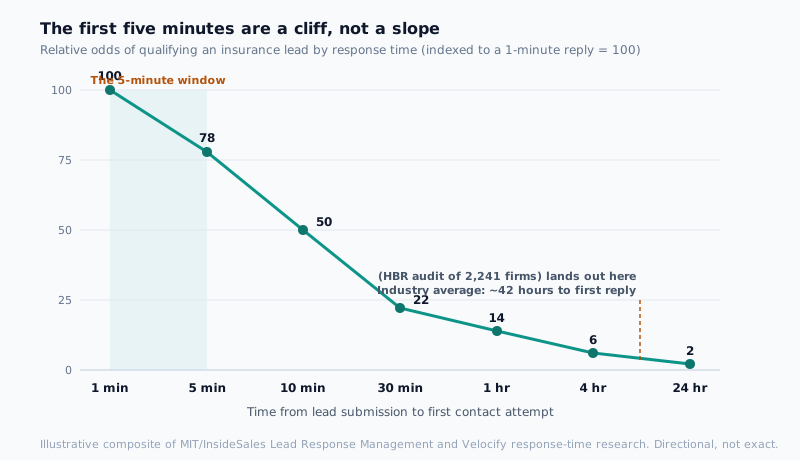
Look at the shape: not a gentle slope but a cliff. Almost all the value lives in the first few minutes; most agencies don't call until they are deep in the flat dead zone.
Why "we're pretty fast" is almost always wrong
Ask any agency owner how fast they respond and most say "within a few minutes, usually." They believe it, because they remember the leads they happened to catch — not the one that came in at 12:40pm during lunch, the 6:15pm lead after close, or the Saturday batch nobody touched until Monday. Those are not edge cases. As we covered in the after-hours lead problem, a large share of internet leads arrive precisely when the office is empty, and those are the ones that quietly rot. Your average is dragged down by the leads you forget. Most owners are shocked when they finally measure it.
It matters because speed sits upstream of everything else — upstream of contact rate, which is upstream of quote rate, which is upstream of bind rate. If someone else reaches the prospect first, none of the downstream work matters. The best closer in the state changes nothing on a lead that already bought from the agency that called in 40 seconds. (Speed and cadence are different problems: speed is the first touch; the 6-dial follow-up cadence is everything after — and it only works if the first touch went out fast.)
Speed to lead does not end when someone picks up. If the call is a live warm transfer, the producer still has about 10 seconds end-to-end before hang-ups climb. Training notes.
Why you can't fix this by "trying harder"
Every owner already knows speed matters. The problem was never awareness. It is arithmetic.
A producer cannot answer a lead in 60 seconds while they are on another call, in a renewal review, at lunch, or asleep. Leads arrive at all hours; humans work some hours. Even a well-staffed team with an alert on every lead is realistically a five-to-twenty-minute responder during business hours and a zero responder the other two-thirds of the day. You could hire a dedicated lead-response seat, but you would pay a full salary for someone idle between leads and still asleep at 7pm when half your leads land — the tradeoff we walked through in hire a producer or automate the dials.
Being first on every lead, at every hour, is the exact shape of work that should be automated: mechanical, time-critical, impossible to staff at human scale.
Where Entrovox fits
Closing the speed-to-lead gap is the problem Entrovox was built around. It makes the first touch instant and automatic, then hands a warm, interested human to your producer.
- The first call goes out in seconds. The moment a lead hits your system — from any vendor, web form, or integration — an Entrovox AI voice agent calls, day or night, weekends included. No queue, no "I'll get to it later," no after-hours gap. You are the 40-second agency in the story above.
- The AI qualifies before a producer picks up. It confirms the prospect is real, interested, and a fit, then warm-transfers the live call with a one-page Transfer Context Card on screen. Producer time goes to conversations, not dialing voicemail.
- Branded, trusted caller ID. A sub-minute call only helps if the prospect answers. Every dial uses branded caller ID, STIR/SHAKEN attestation, and DID rotation so it does not land as "Spam Likely" — the failure mode in the spam-likely post.
- Compliance is enforced on every call. The 8am-to-9pm local window, real-time DNC and revocation scrubbing, and state mini-TCPA overlays apply automatically, so being fast never means being sloppy — more in our TCPA guide.
- Speed plus cadence in one system. If the first call does not connect, the full multi-touch follow-up runs automatically, paced to the high-connect windows — so speed and persistence are one coordinated sequence per lead, not two things a busy producer has to remember.
The economics are simple. You already pay for these leads. If half of them get a first call hours late or never, moving your real response time from hours to seconds multiplies the live conversations your producers get, without buying a single new lead.
What to do this week
Two moves surface the gap before you change anything structural. First, measure your true median response time: pull 90 days of leads and compute minutes-to-first-attempt for every one, including after-hours and lunchtime. Second, split your daytime number from your nights-and-weekends number — they are almost never the same, and the off-hours figure is where most wasted spend hides.
Speed-to-lead is not a growth hack or a clever script. It is the oldest, best-documented edge in lead-based selling, and almost nobody in insurance actually executes it, because until recently no human team could. That is what changed.
Want to see a sub-minute first call run on one of your own leads — qualification, warm transfer, and the licensed agent's Transfer Context Card included?