When Insurance Leads Arrive in a Batch: The One-Producer Bottleneck (2026)
When several insurance leads land in the same few minutes, one producer can only dial one at a time. Here is the throughput math, and how to call every lead at once.
The lead rush nobody plans for
Here is a scene every agency owner knows. It is 12:15 on a Tuesday. A batch of leads drops from your vendor, or your noon ad flight just spent its budget, and eight fresh prospects land in the CRM inside ten minutes. You have one producer free. They are good. They grab the first lead and start dialing.
And that is exactly the problem. They grab the first lead.
While they work it, the other seven sit there. Not because anyone is slacking, but because a person can only be on one phone call at a time. By the time your producer finishes lead one and reaches for lead two, several minutes have passed. By the time they get to lead eight, the prospect has long since filled out three other forms and talked to whoever called first.
You did not lose those leads to a competitor with a better pitch. You lost them to a line.
Why leads come in clusters
The tidy mental model of leads trickling in one at a time, neatly spaced so a producer can pick each one up fresh, almost never matches reality. Leads cluster because the things that make them cluster:
- Vendors deliver in drops. Many lead providers batch and push on a schedule. You do not get one lead every twelve minutes; you get a stack at once.
- Shared leads fire simultaneously. A shared internet lead is sold to several agencies the instant the prospect hits submit. Everyone's batch lands at the same second.
- Ads and campaigns spike. Paid search and social spend concentrate at lunch and in the evening when people actually shop. A mailer or a radio spot lands and the phone lights up for an hour, then goes quiet.
- After-hours leads pile up overnight and all need calling the moment you open, which is its own version of the same pileup. We dug into that one in the after-hours lead problem.
So the average that looks comfortable on a spreadsheet, say 40 leads a day for one producer, hides the truth. The leads do not arrive as a calm stream. They arrive in waves, and the waves are where deals are won or lost.
The math of one producer and one phone
Let us put numbers on it. Say eight leads land together and your producer is free the moment they do, the best possible case. Working each lead, dialing, waiting through the rings, having the conversation or leaving a message, and logging it, takes about six minutes. The work is serial, so the first call to each lead goes out like this:
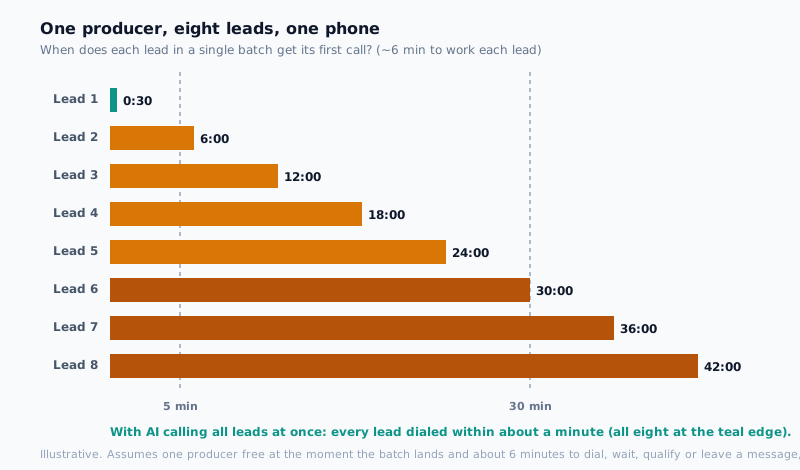
Only the first lead gets called inside the five-minute window. Lead two is already late. Leads six, seven, and eight are not dialed for half an hour or more, and by then the prospect has moved on.
This is the part that stings, because the cost is not hypothetical. The MIT and InsideSales Lead Response Management study found that a lead called within five minutes is about 100 times more likely to be reached and roughly 21 times more likely to qualify than the same lead called at thirty minutes. Harvard Business Review's audit of 2,241 firms found firms that responded within an hour were about seven times more likely to qualify a lead than those that waited even an hour longer.
Your producer did nothing wrong. But six of your eight leads got the thirty-minute treatment, on a stopwatch where the difference between five minutes and thirty is a 21x swing in qualification odds.
You cannot staff your way out of a wave
The instinct is to throw bodies at it. Hire another producer, and another, so there is always someone free when a batch lands. The trouble is the same one that makes missed inbound calls so expensive: peaks and idle time fight each other.
To answer an eight-lead burst inside five minutes, you would need several producers all sitting available at 12:15, the same producers who then have nothing to do at 12:45 when the wave passes. You end up paying for peak capacity you use a few minutes an hour, or you accept that waves overwhelm whoever is on the floor. Most agencies quietly choose the second option without ever deciding to.
There is also the human cost. A producer racing a pile of leads against a clock is rushing every conversation, taking thinner notes, and skipping the follow-up cadence that actually converts leads over six attempts. Speed pressure on people does not create speed. It creates corners cut.
Where Entrovox fits
The bottleneck is concurrency, and concurrency is exactly what software does that people cannot. This is the gap Entrovox is built to close.
- Every lead in the batch gets a first call at once. Entrovox is not limited to one phone line or one person. When eight leads land together, it places the first call to all eight within about a minute, in a natural voice, instead of working them one at a time. The staircase flattens into a single step.
- The AI qualifies in parallel, so your team is not racing. Each prospect gets a real conversation that confirms intent and gathers the basics against your underwriting criteria. Your producers stop sprinting through a pile and start taking calls that are already warm.
- Only qualified buyers reach a human, with context. Interested, qualified prospects are warm-transferred live to a licensed producer with vehicle, coverage, and a qualification summary attached. If everyone is busy, the AI books a callback automatically rather than dropping the lead. Quoting and binding stay with your licensed team, where they belong.
- Compliance runs on every call, not just the calm ones. Instant calls, branded caller ID, calling-hour limits, DNC scrubbing, and AI disclosure all run automatically, on lead one and lead eight alike. That is far easier to guarantee in software than from a team dialing a stack by hand, and the branded ID also keeps your number from getting flagged as "spam likely".
The shift is simple to describe. A human producer can make one first call at a time. Entrovox makes all of them at once, then hands your team the conversations worth having. That is the difference between 40 to 60 leads contacted a day per producer and contacting every lead the moment it lands, no matter how they arrive.
Wondering whether prospects will actually talk to an AI voice? They already do, and there are clear disclosure rules. We covered both in whether AI voices sound human.
What to do this week
You do not need to buy anything to find out whether the wave is costing you. Two checks:
- Pull the timestamps on one busy day's leads. Sort by the minute each one arrived, then by the minute of the first dial. Count how many got a first call inside five minutes. The gap on batch days is usually wider than anyone on the floor believes.
- Watch one lead drop in real time. When the next batch lands, note the clock when your producer starts lead one, then when they reach the last lead in that stack. That number, multiplied by your average bound premium, is the size of the leak.
Then decide how many of those leads were worth never making wait. For most agencies, the answer is all of them.
A batch is speed-to-lead at volume. The category scorecard is AI voice agent for insurance agencies.
Want to see every lead in a batch called at once, qualified, and warm-transferred while your team takes live calls one at a time? Book a 20-minute demo and we will run a test on your real list.