After-Hours Insurance Leads: Why They Never Get a Real Call
Most internet insurance leads arrive after 5pm, when agencies are closed. What happens to after-hours leads, what they cost, and how P&C shops cover that window.
The short answer
After-hours insurance leads are the ones that arrive after the floor is empty — and they are not a rounding error. Across aggregator data, the 5pm to 11pm window is roughly 38 percent of daily internet P&C volume, and the 7pm hour is often the biggest of the day. Calling them at 9:18am is calling someone who already talked to the shop that was open.
This is the night-shift version of speed to lead. For the category scorecard, see AI voice agent for insurance agencies that buy leads.
The lead came in at 7:42pm
Your inbox pinged. Auto-insurance lead from a 32-year-old in Tampa with two cars and a 2018 F-150. Twenty-eight dollars on the invoice. The submission timestamp said 7:42pm on a Tuesday.
It was already 7:43pm. You were on your couch.
By the time your morning shift dialed her at 9:18am Wednesday — 13 hours and 36 minutes after she filled out the form — she had already bound a policy with one of the three other agencies that beat you to her phone. Two of them had called by 7:49pm. One of them was almost certainly an AI.
That lead cost you $28. You will never make it back. And the kicker: somewhere between 35 and 40 percent of every internet lead your agency buys is arriving inside the same after-hours window. You are losing nearly half your pipeline in a place you are not even open.
When P&C leads actually arrive
Most agency owners think of their lead flow as a steady drip across the day with a small bump at lunch. The actual distribution looks nothing like that. Below is a composite of publicly reported aggregator data and broker time-of-day studies from 2023 to 2025. Your own distribution from MediaAlpha, EverQuote, or SmartFinancial will look almost identical.
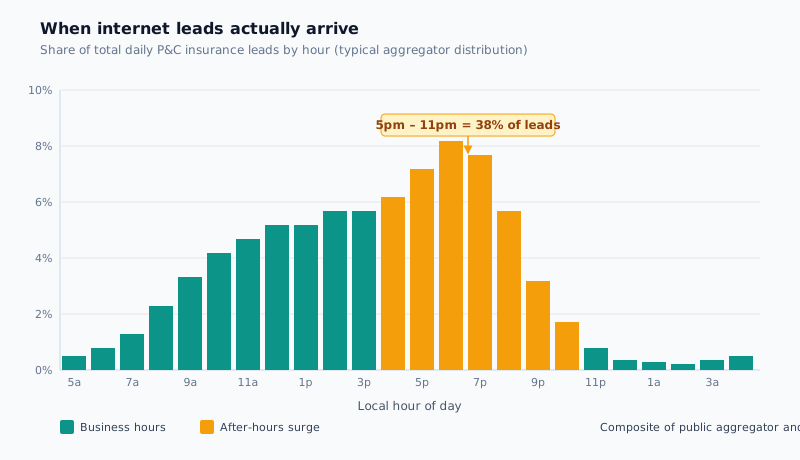
Two things jump out.
First, the evening surge is enormous. The 7pm hour alone is bigger than any single business hour. People shop for insurance after they get home, eat dinner, and finally sit down with a laptop. That has always been true and aggregator data shows it getting more pronounced every year as the smartphone share of submissions grows.
Second, the after-hours window is almost the same size as the entire lunchtime to 4pm block. If you mentally collapse 12pm through 4pm into a single bucket — the heart of "open hours" for a typical agency — it is roughly the same volume as 5pm to 11pm. You are giving half your day-rate of opportunity to leads you are not staffed for.
What actually happens to a 7pm lead
Walk through the journey of that 7:42pm lead at a typical agency.
7:42pm. Lead is generated at the aggregator. Within seconds, the same lead is sold to three to five agencies. Insurance internet leads are almost never exclusive. Every minute you wait, your conversion probability decays against four other dialers.
7:43pm to 8:59am next day. Your CRM ingests the lead. An auto-text fires from your dialer ("Hi this is Sarah from XYZ Insurance, when's a good time to chat?"). It is the same message every other agency sends. It is ignored.
9:18am. Your morning shift starts the day's call list. The 7:42pm lead is now 13 hours and 36 minutes old. The prospect already received an email overnight confirming a quote from one of your competitors.
9:18am to 9:24am. Your agent calls three times, gets voicemail twice, and a "no thanks, I just bought a policy" on the third try. Six minutes of producer time burned. CRM gets a "Lost — already insured" disposition.
End of week. The lead-source ROI dashboard shows MediaAlpha at a 1.8x return. The owner tightens the lead spend. The actual problem — that 38 percent of leads were dead on arrival because nobody was calling at night — never gets diagnosed.
This is not an edge case. It is the modal outcome at most agencies for the largest single bucket of their lead spend.
The math, in dollars
Run the numbers for a hypothetical agency buying 1,000 leads a month at $25 each.
| Bucket | Leads / mo | Cost | Typical bind rate | Bound policies |
|---|---|---|---|---|
| 8am–5pm (called inside 5 min) | 620 | $15,500 | 10% | 62 |
| 5pm–11pm (called next morning) | 380 | $9,500 | 3% | 11 |
| Total | 1,000 | $25,000 | 7.3% | 73 |
Now imagine the same agency closes the gap and calls every after-hours lead within five minutes — even if a human still does the final close the next day. The bind rate on that bucket roughly triples, because the lead is no longer competing with three other agencies that called overnight.
| Bucket | Leads / mo | Cost | New bind rate | Bound policies |
|---|---|---|---|---|
| 8am–5pm (unchanged) | 620 | $15,500 | 10% | 62 |
| 5pm–11pm (called inside 5 min) | 380 | $9,500 | 9% | 34 |
| Total | 1,000 | $25,000 | 9.6% | 96 |
That is 23 additional bound policies a month, on the same lead spend. At an average commission of $180 on the first-term auto policy, that is $4,140 a month — $49,680 a year — pulled out of a budget line that was already being paid for.
The structural unfairness is that the leads you are losing are not lower-quality. They are arriving at the time the buyer is most ready. They are the ones with the most intent. You are just not awake when they show up.
Why "just hire a night shift" does not work
Every agency owner who looks at this chart has the same first thought: fine, I will pay someone to sit at a desk from 5pm to 10pm. Then they do the math and abandon the idea.
The night shift gets, on average, 380 leads spread across six hours. That is roughly one lead every minute at peak. A human producer can dial one lead at a time and is typically on a call for four to six minutes when contact is made. The math does not allow a single producer to keep up with peak hour without rotating leads to next-day anyway — which is exactly the problem you started with.
To actually staff coverage, you need three to five evening producers. At $22 to $28 an hour fully loaded, that is $36,000 to $70,000 a year, before factoring in management overhead, the difficulty of recruiting evening-shift insurance producers, and the fact that they will burn out within six months.
The economics of human-only evening coverage are why almost no independent agency actually staffs it. The few that do are running 20+ producer rooms and treating it as a call-center problem. For a normal 3- to 10-producer P&C shop, evening human staffing is a non-starter.
So the leads pile up overnight. Year after year.
The fixes that do not require a new platform
Before reaching for any new tool, there are three things you can do this week that compound nicely.
Audit your lead arrival distribution. Pull a 90-day export from your CRM with the lead_created_at timestamp. Bucket by hour. Most agency owners have never actually looked at this chart for their own pipeline. The minute you do, the priority of the problem changes.
Negotiate inbound-window scheduling with your lead vendors. Aggregators will, on request, throttle delivery to your business hours. Some agencies turn off after-hours delivery entirely and let competitors burn money on leads they cannot work. This is a bandage, not a fix — you are giving up the highest-intent slice of the day — but it can stop the bleeding while you build a real solution.
Get one autoresponder right. The default agency autoresponder is generic and ignored. A specific, well-written text that references the exact coverage type, the timestamp of submission, and a calendar link to book the morning consult will outperform the default by 4 to 6 percentage points on response rate. That alone recovers a meaningful fraction of overnight leads.
None of these is a structural fix. They are bandages. The structural fix is to actually call the lead — instantly — at the moment of submission.
Where Entrovox fits
The reason we built Entrovox is that the after-hours lead problem is unsolvable with human staffing, and almost every other "AI calling" product on the market is built for outbound campaigns to aged lists rather than for real-time inbound lead response.
What an AI-first agency actually needs at 7:42pm on a Tuesday is:
- A call placed within 60 seconds of the aggregator posting the lead — before the other three agencies on the list even see the email.
- A natural conversation that qualifies on coverage type, current carrier, claims history, and intent — not a script that sounds like a robot reading a list.
- TCPA-aware calling windows so that a 9:12pm lead in Pacific time does not get dialed at 10:12pm Mountain time, but a 7:42pm Eastern lead absolutely does.
- A producer-ready handoff the next morning: calendar booked, transcript on file, a one-page Transfer Context Card so the human producer walks into a warm conversation, not a cold redial.
- Branded caller ID, STIR/SHAKEN A attestation, and DID rotation so the dial actually rings instead of showing up as "Spam Likely" — the topic we covered in our previous post on outbound call flagging.
Every Entrovox call ships all five of those by default. The system queues every after-hours lead, dials it inside the TCPA-allowed window the moment it opens, runs the qualification conversation, and books the lead onto a producer's calendar for the next available shift. The lead has been converted from an internet record into a warm calendar meeting before any of your producers walk in the door.
The math on a 1,000-lead-per-month agency typically pencils out to $40,000 to $70,000 of recovered annualized commission, against an Entrovox platform fee that is a fraction of one full-time evening producer. We do not pretend this is the entire story for every agency — the actual ROI depends on your bind rate, average commission, and how clean your lead vendor stack is — but the after-hours bucket is where the gap is widest at almost every agency we have looked at.
Crucially, Entrovox is not a replacement for your producers. It is the night shift you cannot hire. Your humans still do every binding conversation, every renewal, every cross-sell. They just walk in on Wednesday morning to a calendar of booked meetings instead of a stale list of 13-hour-old leads.
After-hours capture only pays if the daytime producer can take the handoff cleanly. Producer warm-transfer checklist.
What to do this week
If you do not want to evaluate a new calling platform yet, here is the highest-leverage triage sequence for the after-hours problem:
- Run the audit. Export the last 90 days of leads with their
created_attimestamps. Bucket them by hour. Calculate your bind rate by bucket. Most agency owners are stunned by what they find. - Pause delivery during your dead zone. Talk to your lead vendor's account manager and turn off delivery from 9pm to 7am if you have no plan to call those leads. Stop paying for inventory you cannot work.
- Rewrite your autoresponder. Get specific. Reference the coverage type, the time of submission, and a real calendar link — not a generic "we got your request."
- Time-box your morning queue. Make the rule explicit: every after-hours lead is dialed inside the first 30 minutes of the shift, in arrival order, before anything else on the day's call sheet. No standing meetings before 9:30am.
Those four steps alone typically recover 15 to 25 percent of after-hours conversion at zero incremental cost. The structural fix — instant AI response that converts every after-hours lead into a calendar-confirmed meeting — is the next-order move, but the audit is the cheapest first step and the one most owners are missing.
The bigger picture
For 15 years, speed-to-lead has been the single most-cited best practice in insurance distribution, and almost no one has actually solved it for the after-hours window. The economics of human staffing made it impossible. The technology to solve it without humans only became real in the last 24 months.
The agencies that will compound through 2026 and 2027 are the ones that recognize the after-hours bucket as the largest fixable inefficiency in their lead spend. They are not buying more leads. They are calling the same leads they already pay for, at the moment those leads are most likely to convert, and watching the same budget produce 25 to 30 percent more bound policies.
If you want to hear an after-hours lead qualified inside 60 seconds and booked onto a licensed agent's calendar, that is the demo. We will run it on one of your own leads.