How Many Times Should You Call an Insurance Lead? The 6-Dial Rule
How many times should you call an insurance lead? Six attempts is the sweet spot. Most P&C agencies quit at 1–2. The follow-up cadence that actually converts.
The short answer
How many times should you call an insurance lead? Six. That is the research-backed sweet spot for B2C contact, and it is the number this site uses in public copy. Most P&C teams stop at 1.3 to 2.0 attempts because a licensed agent's day is finite — not because the second through sixth dials do not work.
Speed is the first touch. Cadence is everything after. The first-call math is in speed to lead. The category page is AI voice agent for insurance agencies that buy leads.
The 1.3-dial agency
Pull a random lead from your CRM. Look at the activity log.
If you are like roughly four out of five P&C agencies we have audited, the log shows one dial. Maybe two. A generic text the next morning. Then nothing.
Industry-average dial attempts per internet lead, across multiple operator surveys: 1.3 to 2.0. Roughly 44 percent of reps stop after a single attempt. The lead — the one you paid 25 dollars for — sits in the CRM with a "Lost — no answer" disposition and quietly dies.
Meanwhile, the agency down the street is dialing the same lead six times across two weeks, weaving in three texts and two emails, and binding it on attempt four.
That is not a script difference. That is not a producer-talent difference. That is a cadence difference, and it is the single most under-used lever in the entire P&C lead funnel.
What contact rate actually looks like by attempt
The chart below is a composite of the InsideSales/XANT lead-response research, the Velocify "Ultimate Contact Strategy" report, and operator data from several broker-owned agencies. The exact numbers shift a few points across studies, but the shape is identical across every dataset published in the last decade.
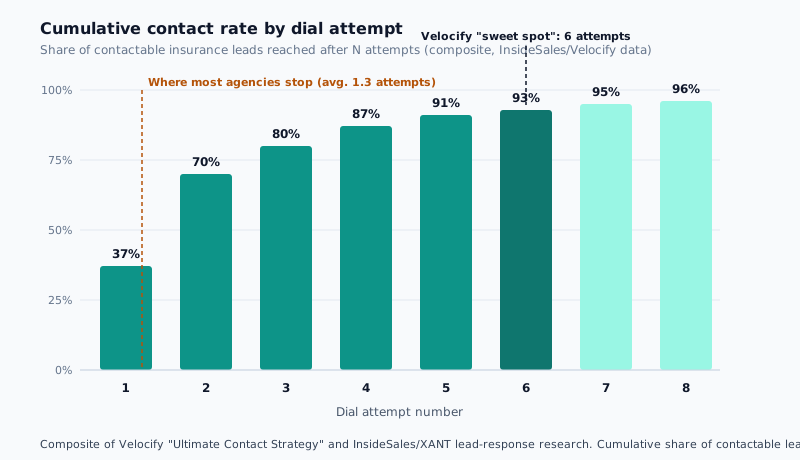
Three things to notice.
The first call gets you only about 37 percent of the prospects you will ever reach on that lead. Not 37 percent overall — 37 percent of the contactable universe. The other 63 percent require persistence.
Attempt two roughly doubles your cumulative reach. This is the single highest-ROI follow-up dial of the entire sequence, and it is the one most agencies skip. If you do nothing else after reading this post, add a mandatory second dial on day one. That alone moves the needle more than any script change.
The curve plateaus hard after attempt six. Going from six to eight attempts gains you maybe three percentage points of contact and starts to look like harassment to the carrier analytics partners watching your DID reputation. Six is the operationally honest answer.
Why "I called and got no answer" is almost never the real story
A "no answer" on attempt one is not signal. It is noise.
Most internet leads are filled out from a mobile phone in a moment of intent — a commute, a kitchen counter, a coffee break. Five minutes later that person is in a meeting, putting kids in a car, or scrolling something else. The fact that they did not pick up at 7:14pm Tuesday tells you nothing about whether they will pick up at 9:30am Wednesday.
The Drift 2023 Conversational Marketing benchmark study found that 78 percent of B2C buyers buy from the vendor that responds first — but "first" is measured against the vendor that reaches them first, not the one that dialed first into voicemail. Multi-attempt cadence is how you stay first when the prospect is finally near a phone.
This is also where the 5-minute rule from the 2007 Oldroyd MIT Sloan study gets misread. The rule is not "call once inside five minutes and you are done." It is "the first dial must land inside five minutes or you lose the head-of-line position to whichever agency did." The cadence comes after the speed.
The cadence that actually works
Here is the default 14-day cadence we recommend for shared P&C internet leads. It is built from the Velocify research overlaid with what we see working in production at agencies running modern dialers.
| Touch | Channel | Timing | Notes |
|---|---|---|---|
| 1 | Call | Inside 60 seconds of lead receipt | The non-negotiable. If the first call lands outside 5 minutes, your contact odds drop roughly 10x. |
| 2 | SMS | Inside 2 minutes after call 1 | Reference the exact coverage type from the form. Generic texts are ignored. |
| 3 | Call | 3 hours after attempt 1 | Same business day if inside TCPA window. Highest-ROI re-dial of the sequence. |
| 4 | End of day 1 | One-page quote summary, calendar link, agency phone number. | |
| 5 | Call | Day 2, mid-morning | Try a different time-of-day than attempts 1 and 3. |
| 6 | SMS | Day 3 | Short — "still want me to run that quote on the RAV4?" |
| 7 | Call | Day 4, late afternoon | Tuesdays and Thursdays produce the highest connect rates per InsideSales data. |
| 8 | Call | Day 6, mid-morning | If still no contact, this is where most cadences should escalate language slightly. |
| 9 | Day 7 | Re-state the comparison value, soften the ask. | |
| 10 | Call | Day 9, late afternoon | The final committed dial in the prime window. |
| 11 | SMS | Day 12 | Last-chance text. |
| 12 | Day 14 | Polite close-out with a 60-day re-engagement queue. |
A few things to call out about this cadence.
Time-of-day matters more than most agencies realize. InsideSales data — replicated several times — consistently puts the highest connect rates between 8am and 9am local time and again between 4pm and 5pm local time. The 11am to 1pm dead zone has the lowest connect rates of the business day. If your call list runs strictly top-down regardless of clock, you are leaving connects on the table.
Day-of-week matters too. Tuesdays and Thursdays consistently produce the highest connect rates. Mondays are dead until about 10am because everyone is catching up on email. Fridays after 2pm are dead because nobody picks up the phone on the way into a weekend.
Channel mix is not optional. SMS response rates run roughly 8 to 12 percent for the cohort that did not answer a voice call, per CTIA aggregate data. Email response rates run 1 to 3 percent for the same cohort. Layering them costs almost nothing and produces real incremental contact.
Why most agencies stop at attempt 2
Sit with any honest agency owner for an hour and the reason they only dial 1.3 times per lead becomes obvious. It is not laziness.
The producer's day is finite. A producer with 80 fresh leads a week, an existing book to service, and an inbound queue to answer simply cannot complete a 12-touch cadence on every lead. The arithmetic does not allow it. So they triage — best-looking leads get two dials, the rest get one.
The CRM does not enforce cadence. Most agency CRMs surface "leads to call" as a flat list. There is no "this lead is due for attempt 3 at 10:30am because the time-of-day matters" prompt. The producer dials, dispositions, and moves on.
Re-dialing the same number feels like nagging. Producers hate it. They will quietly skip the second and third attempts on leads that already went to voicemail once, because nobody likes feeling like a telemarketer.
The economics of human re-dial are bad. Three dial attempts at four minutes each, across 1,000 leads a month, is 200 producer hours. At fully loaded producer cost that is about 5,000 to 7,000 dollars a month just to execute the persistence layer — and that is before the producer ever has a real conversation.
This is exactly the kind of operational problem that humans have been told to "just do better" at for 20 years, and exactly the kind of problem that compounds across an entire industry because nobody actually solves it.
Where Entrovox fits
Multi-touch cadence is one of the cleanest cases for AI calling we know of. The work is mechanical, time-sensitive, and impossible to staff at scale — which is the same set of properties that made after-hours leads and DID rotation impossible to solve manually.
Every Entrovox account ships the full cadence by default, with a few specific behaviors that matter:
- The 6-call sequence runs automatically on every lead. Attempts are spaced according to the time-of-day and day-of-week data above, not just "every two hours." A lead that comes in Friday at 5pm is not dialed three times Friday evening; it is paced into the high-connect Tuesday morning window.
- Calls, SMS, and email are coordinated as one cadence, not three siloed sequences. If the lead replies to the SMS, the dial sequence pauses. If a human producer takes a meeting, the rest of the cadence cancels. There is one source of truth per lead.
- Every dial uses branded caller ID, STIR/SHAKEN A attestation, and DID rotation (covered in detail in our spam-likely post). A 6-attempt cadence from an unflagged, locally-presenced number lands in the prospect's phone differently than the same 6 attempts from a "Spam Likely" string.
- TCPA windows are enforced per attempt, in the prospect's local time zone. Calls outside 8am to 9pm local are queued, not skipped. State mini-TCPAs (Florida, Oklahoma, Washington, others) are applied as overlays. Revocation requests on any channel immediately stop all future touches on that lead.
- The handoff to a human producer is the only attempt your producer ever runs. When the AI reaches the prospect and qualifies, a warm transfer and a one-page Transfer Context Card land on the producer's screen. The producer walks into a primed conversation — not the third cold redial in a row.
The compounding math is the part most agency owners under-estimate. If your current cadence is 1.5 dial attempts at a 40 percent contact rate, and a full 6-attempt automated cadence lifts you to a 90 percent contact rate on the same lead pool, you have roughly doubled the number of conversations available to your producers without buying a single new lead. Bind rate on the bottom of that funnel does not need to move at all for the agency P&L to change meaningfully.
This is the same lever the bind rate benchmarks post called out — contact rate sits upstream of bind rate, and persistence sits upstream of contact rate. Most of the gap between a 6 percent and a 10 percent bind rate is just dials that never happened.
What to do this week, even without changing platforms
If you are not ready to evaluate a new calling stack, here are four moves that cost nothing and surface most of the easy gains.
- Pull a cadence audit. Export the last 90 days of leads and count dial attempts per lead before disposition. If the median is under 3, you have a persistence problem, not a script problem.
- Mandate the day-one second dial. This is the single highest-ROI cadence rule. The second dial, placed 2 to 4 hours after the first, captures the largest incremental block of contacts in the entire sequence. Make it non-negotiable, even if you do nothing else.
- Pace dials to the high-connect windows. 8am to 9am and 4pm to 5pm local time, Tuesdays and Thursdays first. Your CRM probably allows this with a saved view; very few agencies actually use it.
- Add SMS to the cadence. A pre-canned, agent-personalized text after each unanswered dial costs almost nothing to set up and reliably converts 8 to 12 percent of the no-answer cohort to a reply.
Those four steps typically recover 10 to 20 percentage points of contact rate at zero incremental lead spend. The structural fix — a fully automated 6-call, 14-day, multi-channel cadence per lead — is the next-order move. The audit is the cheapest first step and the one almost no agency has actually run on its own data.
The bigger picture
Cadence is one of those topics that sounds boring until you do the math on it. The agencies that compound through 2026 and 2027 will not be the ones who found a better lead vendor or a smarter script. They will be the ones who finally executed the cadence the industry has known about for 15 years — and who used automation to do it on every lead, not just the ones that looked promising on first glance.
Persistence at scale used to require a 20-producer call center. The cost of persistence has now collapsed by roughly two orders of magnitude. The agencies that move first on that collapse will spend the rest of the decade buying the same leads as everyone else and binding 40 to 70 percent more of them.
If you want to see a 6-call cadence run on one of your own leads — branded caller ID, warm transfer, context on the licensed agent's screen — that is the demo.