Insurance Bind Rate Benchmarks 2026: What 'Good' Actually Looks Like by Lead Source
Honest 2026 bind rate benchmarks for P&C insurance agencies by lead source — and the three operational levers that move the number more than anything else.
Every agency owner asks the same question
"What's a normal bind rate?"
It comes up in every owner Slack, every conference hallway, every after-meeting drink. The answer is always vague — depends on the source or ours is six percent — and the asker walks away no smarter.
The vagueness is not anyone hiding anything. It is that the honest answer changes by a factor of 10x or more depending on what kind of lead you are talking about. A 6% bind rate is great on shared internet auto, terrible on warm referrals, and mostly meaningless on a live transfer.
This post lays out honest 2026 benchmarks by lead source, the three operational levers that move the number more than anything else, and the gap most agencies could close on the same lead spend they already pay for.
What "bind rate" actually means
Bind rate is bound policies divided by leads received, expressed as a percentage. That sounds simple. Three traps hide inside it.
Numerator confusion. Some agencies count "applied" as bound. Some count only first-month-paid. Some count effective dates 30 days out. Pick one definition and use it everywhere. If you cannot compare apples to apples across vendors, you cannot make budget decisions.
Denominator scope. Are you counting every lead delivered, or only the ones a producer actually called? A 12% bind rate on the leads producers chose to dial means nothing if half the leads never got touched.
Window mismatch. A lead bought today may bind 14 days from now. Bind rates pulled before the cohort matures undercount. Always look at a cohort that is at least 30 to 45 days old.
Fix those three first. Half the agencies who "know their bind rate" are measuring something different from the agency next door — which makes every benchmark conversation useless.
The benchmarks
The chart below is a composite of vendor-published data (MediaAlpha, EverQuote, SmartFinancial, Datalot), brokerage reports, and a survey of independent agency operators conducted in late 2025 and early 2026. Your mileage will vary, but the ranges cover the middle 80% of agencies running each source competently.
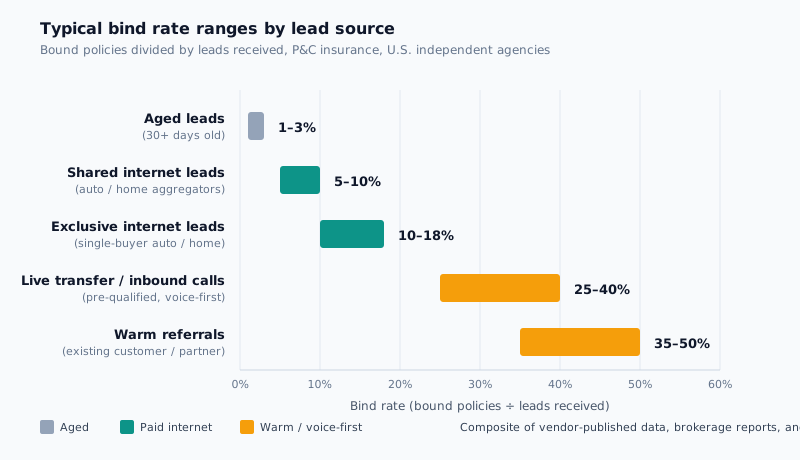
A few things worth calling out:
Aged leads are not worthless — but the math is brutal. A 1-3% bind rate at 3-5 dollars per lead can pencil out as filler when producers have nothing else to dial. It almost never beats fresh inventory on a per-producer-hour basis.
Shared internet leads cluster in the 5-10% range. This is the bread-and-butter inventory for most P&C agencies. The spread inside the range is almost entirely about speed and answer rate, not lead quality. The vendor sells the same lead to three to five agencies. Whichever one calls first and actually rings the phone wins.
Exclusive internet leads bind two to three times higher. Exclusive auto leads in the 40-80 dollar range from quality vendors typically bind at 10-18%. Per-bound-policy math is often close to even with shared once you account for the higher unit price.
Live transfer and inbound calls bind at 25-40%. Pre-qualified calls — Datalot, Contactability, agency-owned inbound — are the highest-converting paid channel and priced accordingly. Expect 40 to 150 dollars or more per qualified call.
Warm referrals run 35-50%. This is the channel most agency owners under-invest in. A referral from an existing customer is the highest-converting lead source in P&C, and the unit cost is a coffee and a thank-you note.
The three levers that move bind rate
Once you have benchmarks, the operational question becomes: am I top-of-range, middle, or bottom? And what actually moves the number?
Across every agency we have audited, the same three levers come up — in roughly this order of impact for paid internet inventory.
1. Contact rate
You cannot bind a lead you never speak with. Industry contact rates for cold internet P&C leads run between 9% and 15% in 2026, down from 25%+ five years ago. The drop is almost entirely about phone behavior — Silence Unknown Callers on iOS, carrier spam filtering, and the slow death of the unsolicited voice call.
Lifting contact rate from 12% to 18% on the same leads is a 50% lift to the entire bind funnel before anyone changes a single word of the script. This is why we keep pointing at branded caller ID and STIR/SHAKEN attestation as the highest-leverage operational fix at most agencies. The dial has to ring before the conversation can happen.
2. Speed-to-first-dial
The 2007 Lead Response Management Study (Oldroyd, MIT Sloan, in partnership with InsideSales.com) examined 15,000+ leads and 100,000+ call attempts. The finding everyone quotes:
- A lead called within 5 minutes is 100x more likely to be reached than the same lead called at 30 minutes.
- A lead called within 5 minutes is 21x more likely to be qualified than the same lead called at 30 minutes.
Multiple replications since — including more recent data from XANT (formerly InsideSales) and Velocify — produced curves of the same shape. The 5-minute window is not a marketing slogan. It is a hard, repeatable property of how people respond to phone numbers they do not recognize.
For P&C insurance specifically, every aggregator sells the same lead to three to five agencies simultaneously. The first dial does not just have higher contact odds; it has the exclusive first conversation. The second and third callers have a steeper hill even if they reach the prospect.
The depressing reality at most agencies: the median time from aggregator timestamp to first outbound dial is between 4 and 8 hours. Half the leads are already dead before the second cup of coffee is poured.
3. Qualification quality at the moment of contact
Once the phone is answered, the conversation has roughly 90 seconds to establish enough trust that the prospect agrees to walk through coverage. Most agency scripts blow it in the first 20 seconds by sounding identical to every other agency that called.
Better qualification — "I see you came in looking for auto coverage on a 2022 RAV4, you mentioned a teen driver, are you also bundling the home?" — beats a generic opener by 15-25% on the same lead pool. The data lives in your CRM if you ever go look at it.
Where most agencies leak
Now overlay the levers on the benchmarks. A typical 1,000-leads-per-month shared-internet shop in 2026 looks like this:
| Metric | Where most agencies land | Where top agencies land |
|---|---|---|
| Contact rate | 10–14% | 22–30% |
| Median speed-to-first-dial | 4–8 hours | Under 60 seconds |
| Bind rate (overall) | 5–7% | 9–12% |
That gap — from a 6% bind rate to a 10% bind rate — is roughly a 70% lift in bound policies on the same lead spend. At 25 dollars per lead and 180 dollars average first-term commission, the difference is 40,000 to 70,000 dollars a year in commission for a 1,000-lead-per-month agency.
The cause of the gap is not lead quality. It is operational. Both agencies are buying from the same vendor. They are receiving the same leads. One of them is calling instantly, ringing through, and qualifying cleanly. The other is calling at 9am the next morning from a "Spam Likely" number with a generic opener.
Where Entrovox fits
Every Entrovox call ships the three levers by default. We did not invent them — they have been industry best practice for a decade — but until recently it was operationally impossible for an independent agency to run all three at scale without a 20-producer call center.
- Speed. Calls placed within 60 seconds of the aggregator posting the lead, 24/7, inside the TCPA-allowed local window. After-hours leads are queued and dialed the second the local 8am window opens the next morning — usually before the prospect has even opened the confirmation email from the aggregator. (See our after-hours lead post for the math on that bucket alone.)
- Contact rate. Branded caller ID showing your agency name on the prospect's screen, STIR/SHAKEN A attestation on every call, DID rotation with cooldown management, and continuous registration with Hiya, First Orion, and TransUnion. Customer answer rates lift 25-35% in the first 30 days.
- Qualification quality. Natural-conversation AI that references the exact coverage type, current carrier, claims history, and intent signals from the lead form. When the AI warm-transfers to a producer, the transcript and a one-page Transfer Context Card are on the producer's screen the moment they pick up. The human producer walks into a primed conversation, not a cold redial.
The compounding math on a 1,000-lead-per-month agency typically pencils out to 40,000 to 70,000 dollars in recovered annualized commission on the same lead spend. The point is not that any single piece of this is magic. The point is that the three levers stack, and they are mechanically out of reach for a human-only outbound stack at agency scale.
Entrovox is not a replacement for your producers. It is the first 90 seconds of every call, plus the night shift you cannot hire. Your humans still own every binding conversation, every renewal, every cross-sell.
What to do this week
If you are not ready to evaluate a new calling platform yet, here is the highest-leverage triage sequence:
- Fix your bind rate definition. Pick one numerator — bound = effective date or first-month-paid — and use it across every vendor and every cohort. Stop letting the metric drift.
- Pull a cohort report. Bucket leads by source and arrival month. Let each cohort mature 45 days. Then compute bind rate. Almost no agency owner has actually done this. The result usually rearranges the lead spend within a week.
- Audit your contact rate, not just your bind rate. Bind rate divided by contact rate is conversion on contact — the cleanest signal of script and producer quality. Most agencies cannot answer this question for their own book.
- Spot-check first-dial latency. Pull 50 random leads from last month. How long between aggregator timestamp and first outbound dial? If the median is over 30 minutes, your bind rate is being capped by speed, not by skill.
Those four steps cost nothing and typically surface a 15 to 25 percentage-point lift opportunity inside the existing lead spend.
The bigger picture
The agencies that will compound through 2026 and 2027 are not the ones buying more leads. They are the ones extracting more bind from the same leads — calling instantly, ringing through, qualifying better, and walking into Wednesday morning to a calendar of booked meetings instead of a stale list of 13-hour-old internet records.
Bind rate benchmarks are useful only if they reframe the question from how do we spend more? to how do we close more of what we already pay for? That is the lever the rest of the industry is about to pull, hard.
Bind rate is the outcome. The outbound jobs that move it are on AI voice agent for insurance agencies.
If you want to see what a 60-second AI dial with branded caller ID and a clean warm transfer looks like on one of your own leads, book a 20-minute demo and we will run a live test call.