The Hidden Cost of a Missed Call at Your Insurance Agency (2026)
Most calls to small businesses never reach a live person, and the caller rarely tries twice. Here is the 2026 math on missed calls for insurance agencies, and how to stop the leak.
The call you never knew you lost
Picture a Tuesday at 11:40 a.m. One producer is mid-quote, the other stepped out, the front desk is signing in a walk-in. The phone rings. Nobody is free. It rolls to voicemail. No message.
You will never see that call in a report as a lost sale, because nothing happened. No record, no follow-up task, no name in the CRM. It is the quietest way an agency loses money, and it happens more than almost any owner realizes.
The number that should bother you
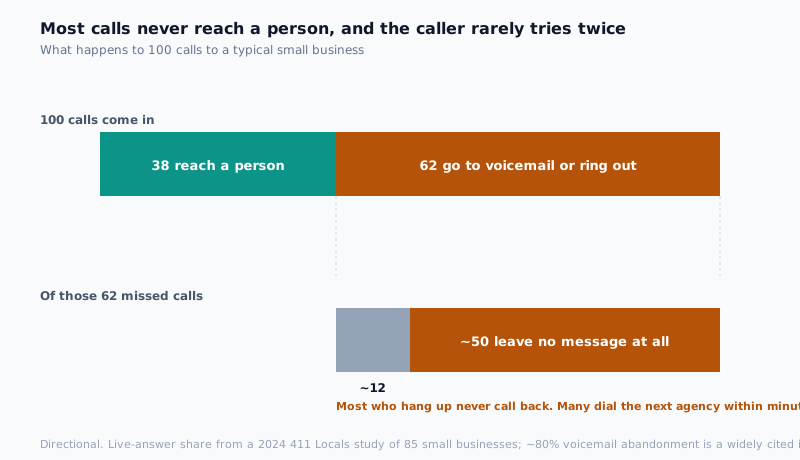
A 2024 study by 411 Locals monitored 85 small businesses across 58 industries for 30 days and found that only about 38 percent of incoming calls were answered by a live person. The rest went to voicemail or rang out.
Read that again. For a typical small business, roughly six of every ten calls never reach a human. Insurance agencies are not the exception. The phone rings during a quote, over lunch, in the renewal-season crush, and after the floor goes home, which is precisely when no one is free to pick up.
The reflex is to assume the caller will just try again. They usually do not.
A missed call is worse than it looks
Here is the part that turns a missed call into a lost customer. Roughly 8 in 10 callers who reach voicemail hang up without leaving a message. And of those who do not reach a person, most never call back. A large share, by commonly cited industry figures, simply dial the next agency in their results.
So a missed call is rarely a call you get a second chance at. It is a buyer making a decision, and the decision is often "next."
Why agencies leak more than most
Two things make this sting harder for an insurance agency than for, say, a pizza shop.
First, the caller is almost always a buyer in motion. A prospect comparing quotes, a returning lead you already paid to generate, or a current client ready to add a vehicle or a policy. Each one carries immediate premium and, more importantly, years of lifetime value if they bind. A single missed call can be a customer worth far more than the call itself.
Second, insurance shopping is a sprint. Someone gathering quotes is dialing several agencies in a sitting. Whoever picks up and sounds helpful first has an enormous edge, which is the same dynamic behind the 5-minute speed-to-lead rule. If your line is busy or rolls to voicemail, you are not "later in the queue." You are out.
It gets worse with the leads you chase. You spend real money on shared and exclusive leads, work them, leave a callback message, and then the prospect calls back during your busiest hour and lands in voicemail. You paid to start that conversation and then missed it on the return leg.
Why "just answer faster" doesn't work
Every owner already knows missed calls are bad. The problem is that the obvious fixes fight the math instead of changing it.
You cannot staff your way to a 100 percent answer rate without paying producers to sit idle between peaks, and peaks are exactly when everyone is already busy. "Grab the phone faster" does nothing at 11:40 a.m. when every seat is full, and nothing after hours, which is when a surprising share of insurance leads actually arrive. A generic answering service catches overflow, but it does not know your leads, your lines of business, or which caller is the returning prospect you have worked all week.
The durable fix is structural: stop so many calls from piling up as inbound in the first place, and make sure the ones that do come back get recognized and routed instead of dumped to voicemail.
Where Entrovox fits
This is the gap Entrovox is built to close, from both directions.
- Fewer inbound calls pile up, because outbound got there first. Entrovox calls every new lead within about 60 seconds, in a natural voice, qualifies real interest, and warm-transfers ready buyers to a licensed producer. When you reach prospects the moment they raise their hand, far fewer of them end up calling you back during your busiest hour and landing in voicemail.
- The returning callers get caught. When a lead you have been working calls the agency back, Entrovox recognizes the returning caller, greets them by name, and routes them with context instead of dropping them into a generic voicemail box. The call that used to vanish becomes a live, qualified conversation.
- Humans stay on the work only humans can do. The AI never quotes rates or binds coverage. It handles the instant dial, the waiting, and the screening, then hands your producer a warm prospect with a one-line summary. Quoting and closing stay with your licensed team.
- It still plays by the rules. Instant calls, branded caller ID, and warm transfers all run inside TCPA and DNC requirements and state calling hours, and the branded ID also keeps your number from getting flagged as "spam likely" so more calls connect in the first place.
When a missed lead is recovered and warm-transferred live, producers need a fixed opener and CRM open before they unmute. Cheat sheet.
Worried prospects will balk at talking to an AI? Today's voice agents are well past the robocall era, and there are clear disclosure rules; we cover both in this post on whether AI voices sound human.
What to do this week
You do not need new software to find out how big your leak is. Two quick checks:
- Call your own main line three times during your busiest hour. Once mid-morning, once at lunch, once near closing. Count how many times a live person picks up before voicemail. If it is not three out of three, you have your answer.
- Pull your call logs for last month and count the unanswered and abandoned inbound calls. Even a rough number, multiplied by your average bound premium, usually lands somewhere that gets an owner's attention.
Then decide which calls are worth never missing again. For most agencies, the answer is "the ones from people ready to buy," and those are exactly the ones worth automating.
Missed inbound is the other half of speed-to-lead. For purchased-lead outbound, start at AI voice agent for insurance agencies.
Want to see your leads called instantly, qualified, and warm-transferred, with returning callers recognized instead of dumped to voicemail? Book a 20-minute demo and we will run a live test on your real list.