Hire Another Producer or Automate the Dials? The 2026 Math for Insurance Agencies
Before you post another producer job, run the math. Here is what a producer really costs in 2026, where their day actually goes, and when automating the dials beats a new hire.
The question every growing agency eventually hits
Leads are coming in faster than your team can work them. The obvious move is the one every agency owner reaches for first: post a producer job and hire your way out of the backlog.
Before you do, it is worth running the actual 2026 math. Because the obvious move is also the most expensive one, and it often solves the wrong problem.
Reframe the question first
"Hire or automate" is the wrong framing. The real question is narrower:
Where is the bottleneck — closing capacity, or contact volume?
If your producers already have more qualified conversations than they can close, you have a closing-capacity problem. Hire. A good producer pays for themselves fast.
But if your producers spend most of the day dialing leads that never pick up, you do not have a closing problem. You have a contact problem. And a second producer dialing into the same wall of voicemail just doubles the cost of the wall.
Where a producer's day actually goes
Here is the uncomfortable part. Across sales roles, reps spend only about 30% of their day actually selling. The other 70% disappears into admin, data entry, prospecting, and dialing numbers that never connect. Salesforce's State of Sales research and older InsideSales time-management studies both land in that range.
Now layer in a fact specific to insurance. Cold internet leads pick up roughly 10–15% of the time on a given dial in 2026, down from 25%+ a few years ago, thanks to spam filtering and "Silence Unknown Callers." So most dials never reach a human at all.
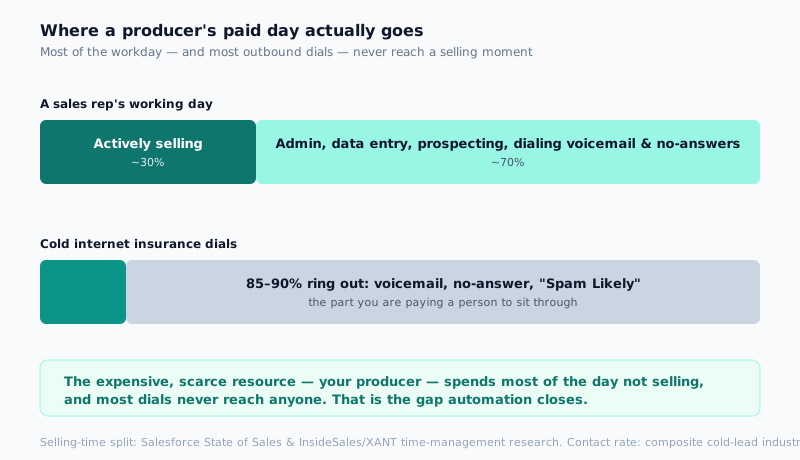
Stack those two facts and a picture forms: you are paying your most expensive, hardest-to-replace people to spend most of their day not selling, and most of their dials to reach nobody. That is the gap.
What a producer really costs in 2026
Base pay for a P&C producer averaged around 65,000 dollars in late 2025, per ZipRecruiter. Add commission and total comp commonly runs 80,000 to 140,000 dollars. Then add the parts that never show on the offer letter: payroll taxes, benefits, a desk, software seats, and a manager's time.
Then add the ramp. A new producer rarely pulls full weight for three to six months. And insurance sales is a famously leaky bucket. Turnover is brutal across the industry, with some channels seeing the majority of agents gone within a few years. SHRM estimates that replacing a departed employee costs six to nine months of their salary once you count recruiting, onboarding, and lost productivity.
So the true cost of "just hire another producer" is not a salary line. It is a salary line, plus a ramp, plus a real chance you are paying that cost again next year.
The math, side by side
Say you are weighing a third producer at a fully-loaded 95,000 dollars a year to chew through your lead backlog.
That producer, generously, spends 30% of the day selling and reaches a live person on maybe 1 in 7 cold dials. The other roughly 65,000 dollars of their cost pays for dialing, waiting, voicemails, and CRM updates.
The alternative is to let software do the dialing grind, instantly and around the clock, and route only the live, qualified conversations to the producers you already employ. You are not buying closing capacity. You are buying back the 70%.
For most agencies working bought internet leads, buying back the 70% returns more selling hours per dollar than a new hire — and it does so without a three-month ramp or turnover risk.
What automation does not replace
To be clear about the line: AI calling does not close policies. It should not try to.
It handles the first dial within seconds of the lead arriving, rings through with branded caller ID instead of "Spam Likely," runs a real qualifying conversation, and then warm-transfers a ready prospect to a human. Every binding conversation, renewal, and cross-sell stays with your producers. You are removing the worst 70% of their day, not their job.
Where Entrovox fits
This is the exact gap Entrovox was built to close. Every lead gets a first dial within about 60 seconds, 24/7, inside the TCPA-allowed local window. Calls ring out with branded caller ID and STIR/SHAKEN attestation so more of them connect. The AI follows a persistent multi-touch cadence instead of quitting after one try. And when a prospect qualifies, it warm-transfers to your producer with the transcript and context already on screen.
Your producers stop being dialers and go back to being closers — which is the only thing you were ever paying them the big number to do. For most shops the result looks less like cutting headcount and more like a lift in bound policies on the same team and the same lead spend.
What to do this week
You do not need to buy anything to test the thesis. Run this quick audit:
- Count live conversations per producer per day. If it is in the single digits, the bottleneck is contact volume, not closing capacity.
- Time a producer's hour. Tally minutes spent actually talking to prospects versus dialing, waiting, and leaving voicemails. The ratio usually shocks owners.
- Pull your contact rate. Live conversations divided by dials. If it is under 15%, a new hire dialing the same list will not move it.
If those three numbers say your producers are dialing more than they are selling, the answer is not another producer. It is taking the dialing off their plate.
If the math says automate the dialing, the outbound scorecard is AI voice agent for insurance agencies.
Want to see what an instant, branded, AI-qualified first call sounds like on one of your own leads? Book a 20-minute demo and we will run a live test call.