How to Get More Google Reviews for Your Insurance Agency (2026)
Your happy clients would leave a Google review if you asked, but almost no agency does it consistently. Here is the 2026 playbook for getting more reviews without being annoying.
The competitor who isn't better than you, just easier to trust
Two agencies sit side by side in the same town. Same carriers, similar prices, both do honest work. A shopper searches "insurance agency near me," and Google shows both. One has 128 reviews and a 4.8, the newest from last week. The other has 6 reviews and a 3.9, the newest from 2023.
The shopper clicks the first one. Not because it's better, but because it's easier to trust. That's the whole decision, and it happened before either agency got a chance to quote.
This is the quiet growth lever most agencies never pull. Reading reviews before choosing a local business is now nearly universal: BrightLocal's 2026 consumer survey found 97 percent of people read reviews before picking a local business, and the share who say they always read them jumped to 41 percent. Google is where they look first. Your reviews aren't a vanity metric. They're the storefront every new prospect sees before they ever talk to you.
Why your review count is low (it's not your service)
Here's the uncomfortable truth: your review count has almost nothing to do with how good your agency is. It has everything to do with how often you ask.
When you leave a satisfied client to review you on their own, very few ever do. People are busy, and a happy client feels no urgency — the ones most likely to post unprompted are the ones who are upset. But when you actually ask, the numbers flip. BrightLocal's 2026 data found that about 83 percent of consumers who were asked to leave a review went ahead and left one. Asking isn't a nudge at the margin. It's the entire difference.
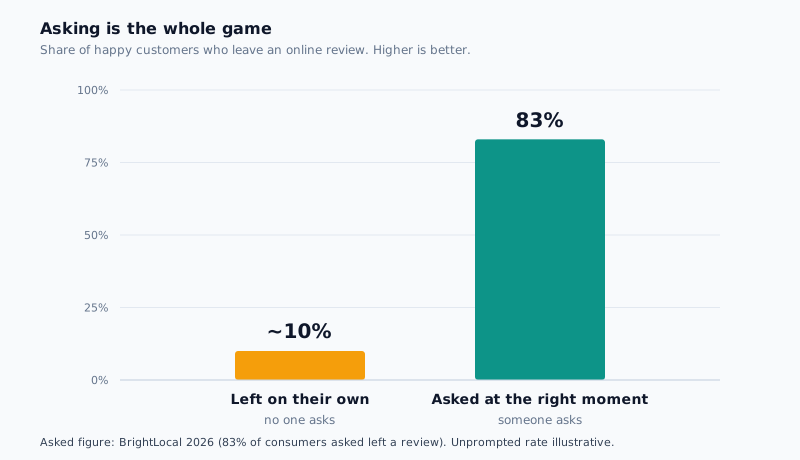
So why don't agencies ask? The same reason the welcome call and the open-quote follow-up never happen: it's quiet, no-deadline work, and nothing in the day forces it. The producer who just bound a policy is already chasing the next fresh lead. The service rep who resolved a claim is on to the next ticket. Asking for a review generates no commission and has no due date, so it loses every prioritization contest to work that's screaming louder. It's not that anyone decided reviews don't matter. It's that no system owns the ask.
Reviews go stale, so this is a trickle, not a sprint
A lot of owners treat reviews as a one-time project: run a campaign, blast the client list, collect thirty reviews, done. That's the wrong shape, because reviews decay.
BrightLocal's 2026 survey found roughly three in four consumers only care about reviews written in the last few months. A wall of glowing reviews from 2023 does surprisingly little — to a shopper it reads as "this place peaked a while ago." Google appears to see it similarly: local-search practitioners note that rankings can slip when a profile stops collecting fresh reviews for even a few weeks, while a steady drip keeps the profile looking alive.
That changes the goal. You're not trying to win a one-time pile of reviews. You're trying to add a few genuine, recent reviews every single month, forever. Which is exactly the kind of consistent, unglamorous cadence that human good intentions are terrible at maintaining and that a system is great at.
The three moments worth asking
You don't ask everyone at a random time. You ask at moments of earned goodwill, when the client actually feels looked after. For an insurance agency, three windows do most of the work.
- Right after a new policy binds. The client just made a decision and feels good about it. A friendly thank-you plus a review ask lands while the goodwill is highest. This pairs naturally with the welcome call you should already be making.
- Right after a claim or service win. A claim handled smoothly, an ID card sent in two minutes, a coverage question answered clearly — these are the moments clients remember. A client who just felt taken care of is your most willing reviewer.
- Right after you save them money at renewal. When you re-shop a client's renewal and come back with a better rate or a bundle that lowers the bill, you've just proven your value. Ask.
The mechanics matter as much as the timing. Make it take ten seconds: hand the client the exact direct link to your Google review page, ideally by text so they can tap it on the spot, not "search for us on Google." Every extra step of friction is another client who meant to and never did.
The lines you don't cross
Getting more reviews is one of the few marketing moves with real rules attached, and crossing them can get your whole profile suspended. Three things to never do:
- Never pay or incentivize. No cash, no discount, no gift card, not even a raffle entry — even for an "honest" review. Google prohibits it, and the FTC's 2024 rule adds civil penalties per violation for incentivized or fake reviews.
- Never review-gate. You can't send the review link only to clients you already know are happy while quietly steering unhappy ones to a private form. Ask everyone the same way.
- Never buy reviews or write your own. Beyond being against the rules, it's obvious to readers and to Google's spam detection, and it torches the trust you're trying to build.
The safe version is refreshingly simple: ask every client, incentivize none of them. If your service is good, honest asking is all you need.
Where Entrovox fits
Asking for a review is close to a perfect job for outbound AI. It's a finite list of people who already chose your agency, the conversation is short and friendly, and it's work that reliably never gets done by hand.
- It asks every client, not the few someone remembered. Entrovox works the full list — new binds, resolved claims, saved renewals — on a schedule you set, so the ask actually happens every time instead of when a producer has a spare minute (never).
- It texts the direct link on the call. The agent thanks the client, asks if they'd be open to leaving a quick review, and sends the exact Google link by text on the same call — killing the friction that loses most would-be reviewers.
- It catches the unhappy ones first. This is the compliant, honest alternative to gating. Because it's a real conversation, anyone who sounds frustrated gets routed to a human to fix the problem, instead of being pushed toward a public review. You're not filtering who can review — you're making sure a fixable issue gets fixed before it turns into a one-star.
- Branded caller ID, so the call gets answered. Every dial carries your agency name and a clean STIR/SHAKEN attestation instead of a "Spam Likely" label, which matters a lot when you're calling to ask a favor.
- It sounds like a person, and it follows the rules. Today's voice agents are well past the old robocall era — we cover that in this post on whether AI voices sound human — and the calling-window, do-not-call, and disclosure guardrails from our TCPA guide run on every call automatically.
It's the same engine behind your speed-to-lead and renewal outreach, pointed at the moment that quietly decides whether the next shopper trusts you or your competitor. If you buy leads, the jobs that decide whether those leads bind are the first five minutes, Spam Likely, after-hours coverage, and six follow-up attempts — the scorecard on AI voice agent for insurance agencies.
What to do this week
You don't need software to start. Two moves get you going today.
- Grab your Google review link and pin it everywhere. Find your Business Profile's "Get more reviews" short link, save it in your phone and your email signature, and put it where staff can grab it in one tap. Half the battle is just having the link ready when the moment comes.
- Ask ten recently-served clients this week. Pick ten people you helped in the last month — a new bind, a claim, a renewal save — and ask each one directly for a quick Google review, then text them the link. You'll be surprised how many say yes, and you'll feel exactly where the process breaks down when you try to do it by hand for the eleventh, and the fiftieth, and the two hundredth.
That last feeling is the whole point. Asking works. Asking consistently, for every client, forever is the part humans can't sustain and a system can. The agencies that own their local search in 2026 aren't the ones with the best service. They're the ones whose happy clients actually said so, out loud, where the next shopper could see it.
Want Entrovox to ask your happy clients for a review at exactly the right moment — branded calls, the link texted on the spot, and a human handoff for anyone who isn't happy? Book a 20-minute demo and we'll run it on your real client list. Or see how the rest of it works at entrovox.com.