Non-Pay Cancellations: The Silent Churn Insurance Agencies Can Stop (2026)
Non-payment is the top reason carriers cancel policies, yet most of those clients never meant to leave. Here is the 2026 playbook for saving policies in the grace window before they lapse.
The clients you lose without ever losing a sale
Ask most agency owners where their churn comes from and they will point to the renewal: the rate went up, the client shopped, a competitor won. That is real, and we have written a whole renewal-call playbook about it. But there is a second leak that is quieter, cheaper to fix, and almost entirely preventable, and hardly anyone works it.
It is the non-pay cancellation. A payment fails, a notice goes out, nobody reaches the client in time, and a policy you already sold quietly falls off the books. No shopping, no objection, no competitor. Just a missed draft and a clock running out.
Non-pay is the top cancellation reason, and it's mostly a mistake
When a carrier cancels a policy it wrote, the single most common reason is non-payment of premium. That shows up again and again across consumer guides and state insurance departments: miss the premium, and the carrier begins the cancellation it is required by law to run.
Here is the part that matters for your book. These are not angry clients. They are people whose card expired, whose bank account changed, whose autopay draft bounced, or who never opened the notice. In the subscription economy this has a name: involuntary churn, the customers you lose to a failed payment rather than a decision to leave. Across subscription businesses it runs anywhere from 25 to 50 percent of all churn, and the people affected would have stayed if someone had simply fixed the payment.
Insurance has the exact same dynamic. A big slice of your non-pay cancellations are clients who fully intended to keep their coverage. They just needed a nudge before the window closed.
The save window is short, and then it's gone
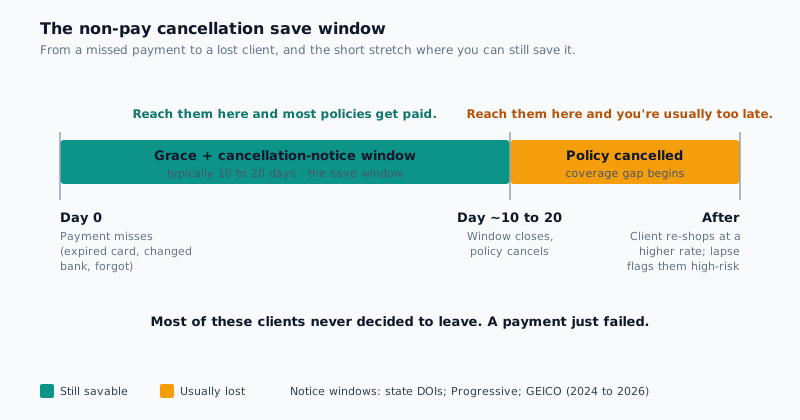
Every non-pay cancellation runs on a timer set by your carrier and state law. The pattern looks like this: the payment misses, the carrier sends a written cancellation notice, a grace period runs (commonly 10 to 20 days, sometimes as few as 3), and if the balance is still open at the end, the policy cancels.
That grace window is the whole game. During it, coverage usually stays active and a single payment keeps the policy in force. After it, the client is uninsured, and getting them back often means a rewrite, sometimes with a fee, sometimes with a fresh lapse on their record.
Why a lapse costs the client more than a late fee
Clients often shrug off a missed payment because they assume they can just start a new policy later. It rarely works out that clean.
Even a short gap in coverage can raise their next premium, and if they have had a lapse recently, insurers flag them as higher-risk automatically. That is not a scare tactic, it is how pricing works. And the stakes are visible in the road data: a 2025 study from the Insurance Research Council found that about 15 percent of drivers were uninsured in 2023, and roughly one in three were uninsured or underinsured. Some of those drivers did not choose to go bare. A payment lapsed and nobody caught it.
So the reminder call is not nagging. It is genuinely protecting the client from a more expensive, riskier position. That framing matters, because it means your team is doing them a favor, not chasing them for money.
The math on saving a policy vs. rewriting one
The financial case is lopsided. Keeping a client is cheap; replacing one is not.
In insurance, winning a new customer costs roughly seven to nine times more than keeping an existing one. So every non-pay cancellation you fail to catch forces you to spend seven-to-nine-times dollars buying a stranger just to get back to where you were. And retention compounds: Bain's classic research found that lifting retention by 5 percent can raise profit by more than 25 percent in financial services, because kept clients renew, buy more lines, and refer.
A saved policy is not just this month's premium. It is the renewals, the cross-sell, and the referrals you keep the right to earn. A payment reminder that takes two minutes protects all of it.
The catch: nobody works the pending-cancel list
If this is such easy money, why do agencies leak it? The same reason the welcome call and the renewal check-in fall off the calendar: staffing.
The pending-cancellation list is a daily job. Carriers flag new clients every day, each with a window closing on a different date, and the outreach that works is fast and repeated. Your producers are paid to close new business and handle claims, not to dial a list of people who mostly do not pick up on the first try. So the list sits. The windows close. The policies cancel one by one, and it never looks like a crisis because no single loss is dramatic. It is a slow drip that adds up to real book erosion by year end.
Where Entrovox fits
This is precisely the kind of high-volume, time-sensitive, low-glamour outreach that breaks when you staff it by hand and runs beautifully when you automate it. Entrovox is an AI voice agent built for insurance outbound, and pending-cancellation outreach is a natural fit.
- It works the whole pending-cancel list on schedule. Every flagged client gets a prompt, friendly reminder call before their window closes, whether that is 10 clients today or 200. No name slips off the list.
- It reaches people fast and follows up. The agent can call the same day a client is flagged and try again across the grace window, instead of the one-and-done attempt a busy producer manages.
- It hands off the moment a human is needed. A client who wants to pay, update a card, or ask why they got the notice is warm-transferred live to a licensed team member with a one-line summary.
- It frees your team for the real saves. The AI absorbs the dialing and the voicemails so your people spend their time on the accounts that actually need a human touch.
And yes, today's voice agents sound human, and the same TCPA and calling rules you already follow apply. Calling your own active clients about their own policy is a routine service call, the kind people expect from an agency that has their back.
What to do this week
Pull your non-pay cancellations from the last 90 days and count them. Then ask one question about each: did anyone actually call this client before the window closed? For most agencies, the honest answer is no, and that gap is some of the cheapest revenue you will ever recover, because you already earned it once.
Lapse prevention is a cadence job. The outbound scorecard for shops that buy leads is AI voice agent for insurance agencies.
Want your pending-cancellation list called every day, reminders sent before the window closes, and payment questions warm-transferred to your team? Book a 20-minute demo and we'll run it against your real book. Or see how the rest of Entrovox keeps your book from leaking.