Account Rounding in 2026: Why Your Monoline Customers Are Your Cheapest Growth
Monoline P&C customers retain at ~83%; bundled households at ~95%. Here is the cross-sell and retention math that makes your existing book cheaper growth than any lead you can buy in 2026.
The renewal that walked without a word
A customer — auto only, three years with you, never a late payment — got a renewal notice with a $40 bump. She didn't call you. She opened her laptop, typed her info into a comparison site, and twelve minutes later bound auto and home with a carrier that bundled both for less than she was paying you for one.
You didn't lose her on price. You lost her months earlier, the day you wrote her auto policy and never called again. She was monoline, and monoline customers are the easiest customers in your book to lose — and the cheapest ones to grow. Most agencies do neither.
The leak you can't see on a dashboard
Your dashboard shows new business. It rarely shows the slow bleed underneath it.
A monoline auto customer retains at roughly 83 percent a year. Bundle that household with home and retention climbs to about 95 percent (McKinsey; J.D. Power's 2022 home-insurance study pegs non-bundlers at 85 percent and bundlers at 95 percent). Flip those into the number that actually costs you money — customers lost per year — and the gap is stark.
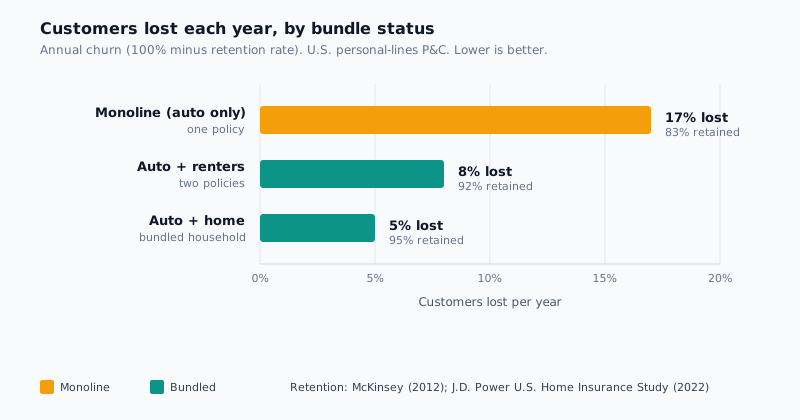
A monoline book loses more than three times as many customers a year as a bundled one. On a 2,000-customer book, that's the difference between losing about 100 households a year and losing 340. Every one is a policy you have to replace with a $20–$30 lead just to stay flat.
It gets worse. J.D. Power's 2025 shopping study found one in three auto shoppers is actively looking to bundle, and LexisNexis reports more than 45 percent of in-force policies get shopped at least once a year. Your unbundled customers aren't just easier for you to grow — they're the exact prospects every competitor is courting.
Why monoline customers leave (and bundled ones don't)
Two reasons, both boring, both fixable.
First, switching is frictionless for one policy and a headache for two. A bundled household has to re-quote and re-coordinate two coverages to leave, so inertia works in your favor — but only once you've earned the second policy. McKinsey found the auto-plus-home bundle nearly halves a customer's likelihood of shopping at all.
Second, contact. Agency Performance Partners reports that 65 percent of customers who leave never spoke to their agent, while 80 percent of those who had a conversation in the past year stayed. A monoline customer who hears from you once at the sale and never again has no relationship to defect from. Silence is the cancellation you don't see coming.
The cross-sell is cheaper than any lead you'll buy
Here's the part that should change how you spend Monday morning.
The probability of selling to an existing customer is 60 to 70 percent. For a cold prospect it's 5 to 20 percent (Marketing Metrics, Wharton). You already have the relationship, the data, and the payment method on file. A monoline auto customer is the warmest "lead" you'll ever touch — and you already paid to acquire them once.
Now stack retention on top. In Reichheld and Sasser's original Harvard Business Review research, cutting customer defections by just 5 percent lifted profits 25 to 85 percent depending on the business — and the insurance-brokerage data point landed near 50 percent. Cross-selling isn't a side hustle to new business; for most agencies it's the highest-return activity available, and it compounds. Every bundle you write today is a household still on the books in three years, referring its neighbor.
So why doesn't every agency run the book hard?
The same reason aged leads sit untouched
It's the labor-cost problem again. We ran this math for aged leads: a producer's time is the binding constraint, and producers spend it where the commission feels biggest — chasing fresh quotes, not calling existing customers to "review their coverage."
Calling 1,500 monoline customers to offer a home quote is nobody's favorite Tuesday. It's repetitive, most calls hit voicemail, and the payoff is diffuse. So the book sits there, retaining at 83 percent, quietly leaking, while everyone dials new leads 1.3 times each and gives up.
The average independent agency carries around 1.6 policies per customer. The best multiline shops clear 2.0. The gap between those two numbers is sitting in your CRM right now, unworked, for exactly the reason aged leads sit unworked: nobody has the hours.
Where Entrovox fits
This is the cleanest fit for outbound AI calling there is, because the work is high-volume, repetitive, and aimed at people who already know you.
- Coverage-review and cross-sell calls across the whole book. An AI voice agent calls every monoline customer with your name on the caller ID, runs a friendly "let's make sure your coverage still fits" conversation, surfaces the home, umbrella, or life gap, and warm-transfers anyone interested straight to a producer. At a marginal cost well under a dollar a call, working 1,500 monoline customers stops being a someday project.
- Pre-renewal outreach. Reach every household 30 to 45 days before renewal — before the bump notice triggers a shopping spree. A two-minute "anything change this year?" call is the cheapest retention insurance you can buy.
- A lower-risk consent posture. Calling your own active policyholders generally falls under the established business relationship exemption to the National Do-Not-Call Registry — a materially safer footing than cold-purchased leads. Entrovox still honors your internal do-not-call list, opt-outs, state calling windows, and revocations on every dial.
- Producers do the closing. The AI opens the door and qualifies; your humans write the bundle, on the same warm-transfer path as your new-business flow.
What to do this week
Three moves, no new platform required:
- Pull a monoline count. Filter your CRM for customers with exactly one policy. That single number is both your retention risk and your cross-sell pipeline.
- Sort by renewal date. Anyone renewing in the next 60 days you haven't spoken to all year is a flight risk. Call them first.
- Run one small cross-sell batch. Auto-only customers who own a home are the obvious start. A hundred calls will tell you your real cross-sell rate — almost always higher than owners expect.
You bought this book once. Working it is the cheapest growth you'll find — and the only thing standing between you and a 2.0-policy household is the hours to make the calls. That's the part that's now solvable. The same muscle that works a monoline book — speed to lead, six follow-ups, branded caller ID — is the outbound job on AI voice agent for insurance agencies. Book a 20-minute demo and we'll run a live coverage-review call to your own phone so you can hear what working the book sounds like.