Aged Insurance Leads in 2026: The Cost-Per-Bind Math Most P&C Agencies Get Wrong
Aged P&C leads cost 70–95% less than fresh — but bind at a fraction of the rate. Here is the honest cost-per-bind math by age tier, and why the answer flips depending on who is dialing.
The aged-leads folder nobody opens
Open your CRM. Sort by lead age, descending. Scroll past 30 days.
There they are — hundreds or thousands of records, each with a phone number, a vehicle, a coverage need, and a "Lost — no answer" disposition from a producer who dialed once two months ago. Every one of them cost real money to acquire. Most agencies treat them like fossils.
Here is the uncomfortable part: those same records are sold every week, at deep discount, to other agencies as "aged leads." The vendors you buy fresh inventory from — MediaAlpha, EverQuote, SmartFinancial, QuoteWizard — also sell the same forms back into the market once they age past the fresh window. Buyers exist. The leads still bind. The question is whether they bind at a price you can profitably pay for.
This post is the honest math.
What "aged" actually means
There is no single industry definition. In practice, lead vendors slice the aging curve into roughly five tiers, with pricing that drops by a factor of two to four between each tier.
| Age tier | Typical pricing (auto/home, 2026) | Defining characteristic |
|---|---|---|
| Fresh (0–72 hours) | $18–$30 per lead | Sold simultaneously to 3–5 agencies. High competitive pressure. |
| 7-day | $7–$12 | Most easy contacts already made by the original buyer. |
| 14-day | $4–$7 | Original buyers have moved on. Lead largely uncontested. |
| 30-day | $1.50–$3 | Real intent has cooled. Some prospects have already bought. |
| 60-day | $0.50–$1.50 | Mostly dormant. Long-tail conversion only. |
| 90-plus day | $0.25–$0.75 | Bulk inventory. Sold in large lists, not individual leads. |
Pricing varies by state, lead source (auto vs. home vs. health), and demographic filtering, but the shape is consistent across every vendor that publishes a rate card.
The form data on a 90-day aged lead is identical to the data on a fresh lead. The prospect's age, location, vehicle, coverage need, current carrier — all the same fields, the same answers. What changed is the freshness, and the price.
Why the price drops so fast
Three things compound as a lead ages.
Easy contacts get burned. The first agency to dial a fresh lead reaches roughly 37 percent of them on attempt one (see our follow-up cadence post). The second and third agencies dial the same prospect within minutes. By day three, anyone who is going to answer their phone for an insurance call has answered it several times. The remaining pool skews toward harder contacts — people who do not pick up unknown numbers, who use call screening, who already bound elsewhere.
Real intent cools. The MIT speed-to-lead study (Oldroyd 2007, replicated dozens of times since) found a roughly 10x drop in contact odds between five minutes and 30 minutes after lead submission. The slope flattens but never stops. A 30-day-old lead is talking to a different person — same prospect, but the urgency that made them fill out a form at 7:42pm Tuesday is gone.
Bound policies subtract from the pool. Roughly 60 to 75 percent of internet leads end up bound somewhere within 30 days — usually with the first agency to actually answer them or with the prospect's existing carrier. By the time you buy a 30-day aged lead, you are working a pool where two-thirds of the prospects already have a new policy in force.
This is why the pricing falls faster than amateur math would suggest. Vendors are not running a loss-leader. They are pricing in proportion to the real probability of conversion.
Bind rate by age — the honest numbers
A reasonable 2026 baseline, drawn from vendor-published data, aggregator reports, and operator interviews:
- Fresh (0–3 days): 5–10 percent bind rate. Median around 6.5 percent on shared internet inventory. (Our bind rate benchmarks post breaks this down by lead source.)
- 14-day aged: 3.5–5 percent.
- 30-day aged: 2–3 percent.
- 60-day aged: 1–2 percent.
- 90-plus day aged: 0.5–1 percent.
If you see numbers wildly higher than this on aged inventory, two things are usually true: the agency is filtering aggressively (only buying aged leads in specific states, demographics, or coverage tiers), or they are running an automated workstream that touches every lead in the file rather than cherry-picking. Manual producer dialing on raw aged inventory rarely beats these bands.
The cost-per-bind math
Here is where most agencies get fooled in both directions.
On lead cost alone, the math looks irresistible. A 30-day aged lead at $2 with a 2.5 percent bind rate yields $80 per bound policy on lead spend — far below the $338 you spend per bound policy on $22 fresh leads with a 6.5 percent bind. By that math, aged leads should be a no-brainer.
They are not, because lead cost is not the only cost. Producer labor is.
Assume your producer spends roughly $5 of fully-loaded time per dial attempt (salary, benefits, phone, dialer seat, allocated overhead — the real number for most independent agencies in 2026). Run the recommended six attempts per lead and that is $30 in labor per lead, regardless of whether you paid $22 or $2 for the form.
Now the math:
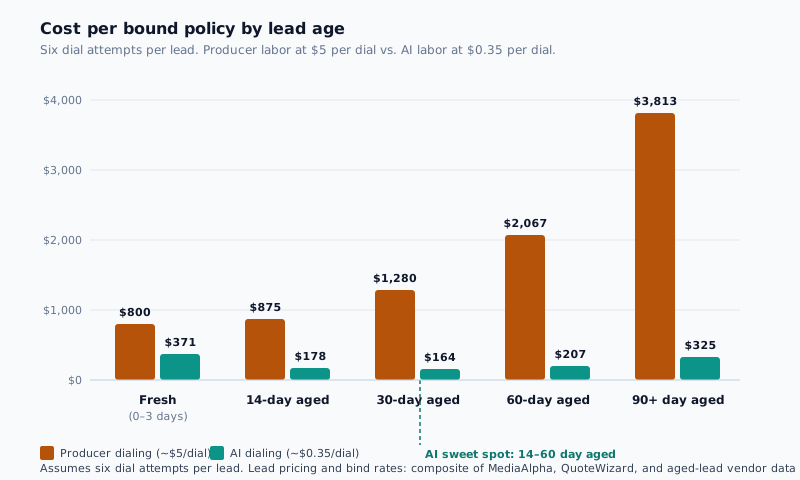
Read the orange (producer) series first. Fresh leads — six dials, six dollars, low bind rate but also low age penalty — cost roughly $800 per bound policy when you include labor. By 30 days, cost-per-bind climbs to $1,280. By 90 days, it is $3,813. With producer labor, aged leads do not just fail to beat fresh — they get progressively worse, the older they get.
That single chart is why most agency owners stop calling aged leads after their first attempt. Their producers correctly read the dynamic: "every minute I spend dialing a 60-day lead is a minute I could have spent on a fresh one for the same labor cost and four times the bind probability." The producer is right. The agency owner who lets them ignore the file is also right.
Now read the teal (AI) series. The labor cost drops from $30 per lead to roughly $2.10 ($0.35 per dial × six attempts). Suddenly the lead-cost advantage actually compounds: cost-per-bind on a 30-day aged lead drops to $164 — less than half the $371 you spend per bound policy on the same agency's fresh leads.
The age sweet spot moves. With producer labor, you should only work fresh inventory. With AI labor, the 14- to 60-day band becomes the most efficient channel in your funnel.
Where the aged-lead story breaks down
Two real caveats, both worth pricing in.
Bound-elsewhere probability. Even if your AI reaches a 30-day aged prospect, a third or more of them have already bound a policy with someone else. Your qualification script needs to surface this fast — "Are you currently insured? When does your policy renew?" — and disqualify quickly so you do not waste minutes on a dead conversation. A well-tuned voice agent can do this inside the first 45 seconds of a call.
Consent and DNC drift. Valid TCPA consent on the original lead form does not expire on a fixed federal timeline, but two things change as the lead ages. Prospects add their numbers to the federal DNC registry at a rate of roughly 5–8 percent per year. Some explicitly revoke consent (a verbal "stop calling me" to a prior agency, a written request, or a CRM note from a previous buyer). Both must be honored, and both must be re-scrubbed before any aged call.
The FCC's 2024 one-to-one consent rule, in effect since early 2025, also tightens what counts as valid consent for leads that were sold or re-sold to multiple buyers. The original lead form must have disclosed your specific agency (or used language broad enough to include you) for the consent to legally cover your call. If you are buying aged inventory from a vendor whose consent language only covered the original buyer, you are exposed. Demand the actual consent disclosure text from the vendor before you run any aged file.
These are not arguments against working aged leads. They are arguments for working them through a compliance-aware system rather than handing a CSV to a producer.
Why most agencies do not work aged leads (and why that creates the opportunity)
Walk into ten independent P&C agencies and ask whether they work aged inventory. Maybe two say yes. Of those two, one is running a half-hearted "we call them when leads are slow" workstream. The other has built an actual machine.
The reason the other eight do not is rational. The math we just walked through is the math their producers are running in their heads every morning. With $30-per-lead labor cost, aged leads are bad business. Telling a producer to spend their day on 60-day leads is asking them to take a 50 percent pay cut for the same effort.
The economics flip the moment dialing becomes a marginal-cost activity instead of a labor-cost activity. Once an AI agent can execute the full cadence on every lead in a 5,000-record aged file — overnight, in parallel, with branded caller ID and full compliance scrubbing — the value of that "dead" inventory is no longer hypothetical. It is calculable, repeatable, and (this is the part that matters) sitting in the CRM of nearly every agency you compete with, unworked.
The competitive moat here is not access to aged leads. The vendors will sell them to anyone with a credit card. The moat is operational: who has the dialing infrastructure to actually work them?
Where Entrovox fits
We are not selling aged leads. We do not have an exclusive vendor relationship. Buy your aged inventory from whoever you trust — InsuranceLeads.com, NextGenLeads, Benepath, your fresh-lead vendor's aged-inventory channel, all of them.
What Entrovox does is the part most agencies cannot run themselves: the dialing engine that makes aged inventory actually economical.
- Sub-$0.50 marginal cost per dial. The same voice infrastructure that calls fresh leads in 60 seconds runs the aged file at the same per-call cost. No producer time consumed.
- Full six-attempt cadence across the whole file. Every aged lead gets the same cadence as a fresh one — six calls, three to five text touches, two emails, spread across 14 days, weighted to the time of day each prospect is most likely to answer. The cadence we wrote about in the six-dial post applies whether the lead is 4 hours old or 40 days old.
- TCPA-aware compliance at dial time. Every dial is re-scrubbed against the federal DNC registry, state-specific calling-hour windows, and your suppression list. Revocation events from prior conversations are honored immediately. The lead vendor's original consent disclosure is stored against each record so you can answer an E&O question with a single click.
- Branded caller ID and STIR/SHAKEN A attestation. Aged leads are dialed from a healthy DID pool with your agency name on the prospect's screen. This matters more on aged inventory, not less — the older the lead, the harder the contact, the more critical that the call rings as you instead of "Spam Likely." (More on the answer-rate side of this in our spam-flagging post.)
- Same warm transfers, same qualification. Aged leads that reach a real conversation flow through the same qualification logic and warm-transfer path as your fresh leads. Your producers do not need to know whether a transferred call started life as a 24-hour or 24-day-old form.
The pitch is not that aged leads are a new revenue stream. The pitch is that the inventory you (or your competitors) already paid for, sitting in your CRM, has measurable bind value once the labor cost of working it drops below the lead's economic threshold.
What to do this week, even if you do not change platforms
Three moves you can run yourself:
- Audit your own aged file. Sort your CRM by lead age. How many leads older than 30 days have a "no contact" or "lost — no answer" disposition? That is the size of the opportunity sitting in your own database. You already paid for these once.
- Re-scrub against DNC. Before doing anything else with aged inventory (yours or vendor-bought), run it through a DNC scrub. The legal cost of one TCPA violation in 2026 vastly exceeds the operational cost of scrubbing. Multiple low-cost services do this — DNC.com, Contact Center Compliance, others. This is the minimum hygiene step.
- Pilot a 14- to 30-day aged file. Buy a small batch (200–500 leads) of 14- to 30-day aged inventory from a vendor whose consent disclosures clearly cover your agency. Run it through whatever calling capacity you have available. Measure cost-per-bind honestly — lead cost plus real labor cost — and compare against your fresh-lead numbers. If the math works with your current dialing setup, you know aged is a channel. If it does not, you know what would need to change.
The structural play is bigger — running the whole aged tail of your CRM at scale, every day, on AI infrastructure — but you do not need to commit to that to learn whether aged inventory makes sense for your book.
The bigger picture
For two decades, the answer to "should I work aged leads?" has been "only if your producers are bored and there is no fresh inventory." That answer was correct because producer labor was the binding constraint. With producer labor as the dominant cost, the cheapest lead in the world cannot beat a fresh lead.
What changed in 2024 and 2025 is not the leads. The leads are identical. What changed is the cost of dialing. AI voice agents that can execute a producer-quality conversation at roughly seven percent of producer labor cost are not a marginal improvement — they shift which inventory tiers are profitable.
The agencies that figure this out first get to work a channel their competitors structurally cannot afford to touch. The agencies that do not figure it out keep buying $22 fresh leads, dialing them 1.3 times, and watching the rest of their lead spend evaporate into a folder no one opens.
Aged inventory only pays if the outbound job is covered — first dial, branded caller ID, six follow-ups. That scorecard is AI voice agent for insurance agencies.
If you want to see what an aged-lead workstream looks like end-to-end — dialing, qualification, compliance scrubbing, warm transfer — book a 20-minute demo and we will run a test call to your own phone from an aged-lead scenario so you can hear it before you buy anything.