Insurance Lead Surges: How to Work Record Shopping Without Hiring (2026)
Insurance shopping just hit a 19-year record, so lead volume spikes while producer capacity stays flat. Here is how to work every surge lead without over-hiring for a spike that passes.
The short answer
Insurance shopping is at its highest level in nearly two decades, which means more leads are in the market than at any point in living memory. The catch is that lead volume arrives in spikes — a big rate filing, a storm season, a marketing push — while a team of human producers can only work a flat amount of leads fast enough to matter. The agencies that win a surge are the ones that can flex their calling capacity up and down on demand, without hiring for a spike that passes and then paying for idle seats once it does.
Why insurance shopping is surging
The trigger is simple: price. When premiums jump, people shop. And premiums did not just jump, they leapt. Motor vehicle insurance prices rose about 20% year over year in early 2024, per the BLS Consumer Price Index — one of the steepest runs in decades and a real driver of headline inflation that year.
Every one of those increases sent a customer looking for a better number. J.D. Power's 2025 U.S. Insurance Shopping Study found that 57% of auto customers shopped their policy, up from 49% the year before — the highest shopping rate in the study's 19-year history. The rate hikes have since cooled to the low single digits, but the habit stuck, and shoppers are still elevated.
Home insurance is now doing the same thing. Premiums climbed a cumulative ~47% between 2020 and 2025, and among homeowners who say they won't renew, 43% blame the price increase. For an agency, a market full of shoppers is a market full of leads. The opportunity is real. The question is whether you can actually work it.
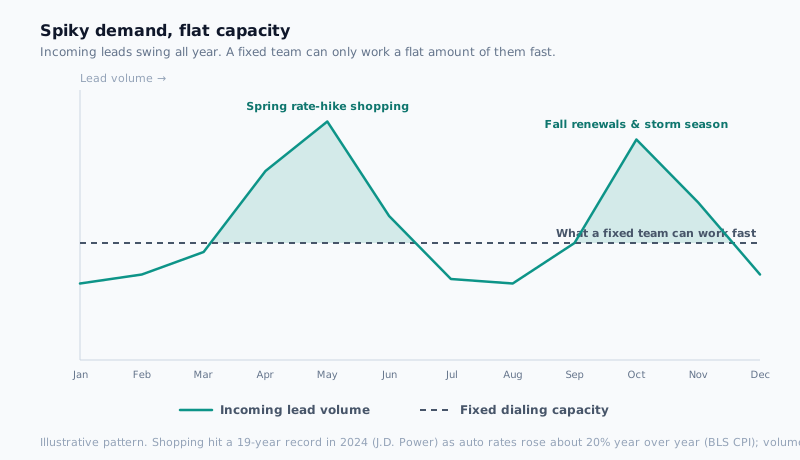
The real problem isn't volume. It's that volume is spiky.
If leads arrived at a steady drip, this would be a solved problem. You would measure the drip, staff to it, and move on. But they don't. Surges cluster around a handful of triggers — carrier rate filings landing in waves, storm and wildfire seasons, the auto renewal cycle and X-date windows, and your own marketing pushes — and none of them arrive gently.
Here is the part that quietly costs the most. During a spike, the overflow leads don't get a slower version of your process. They get no process. They sit in the CRM while your team works the leads it can reach, and by the time anyone dials, the prospect has already talked to a faster agency. As the speed-to-lead math shows, a lead contacted in five minutes is about 21 times more likely to qualify than one contacted at 30 — and surge leads routinely wait hours or days. You paid for every one of them, and the spike is precisely when the most of them go to waste.
Why hiring can't catch a spike
The instinct is to hire your way through it. But the timing never works. Hiring takes weeks to fill and three to six months to ramp, and by then the surge has passed. You cannot post a job in response to a rate filing and have a productive producer in the seat before the shopping wave rolls through.
That leaves the classic fixed-capacity trap. Staff for the peak and you carry idle payroll through every trough. Staff for the trough and you leave surge money on the table exactly when it is most abundant. Either way you are matching spiky demand with a fixed resource, which is the one thing that resource is worst at. (This is a cousin of the hire-or-automate question: a new producer helps when your bottleneck is closing conversations, not when it is the raw volume of first dials nobody has time to place.)
Where Entrovox fits
The fix is to separate the work that spikes from the work that doesn't. The binding conversation is human and roughly constant. The first call, the qualifying, and the follow-up cadence are mechanical and volume-driven — and that is the part that should flex on its own. Splitting them is the whole idea behind Entrovox.
- Elastic first-touch capacity. An Entrovox AI voice agent places the first call within about 60 seconds of a lead landing, whether 10 leads arrive that minute or 1,000. There is no queue that backs up under load, so a surge gets the same instant first touch as a slow Tuesday. Your calling capacity scales to the spike and scales back down when it passes, with no hiring cycle and no idle seats.
- Your producers only meet qualified people. The AI qualifies the prospect, then warm-transfers a live, interested caller to a human with the context already on screen. Your fixed, expensive human capacity is spent only on conversations worth their time — which is what lets a busy month feel like closing, not drowning.
- The surge still connects. Volume is worthless if the calls don't land. Every dial uses branded caller ID and STIR/SHAKEN attestation so it doesn't show up as "Spam Likely", and a persistent multi-touch cadence runs on the leads that don't pick up first time.
- Compliance holds under load. The 8am-to-9pm local calling window, real-time DNC and revocation scrubbing, and state mini-TCPA overlays apply automatically on every call, so scaling up fast never means getting sloppy.
The economics are the whole point. You already pay for surge leads. If the reason they go cold is that no human could reach them in time, then making the first touch instant and infinitely scalable turns the surge from a source of waste into your best month — on the team and the lead spend you already have.
What to do before the next surge
You don't need to buy anything to see whether this is your problem. Three numbers tell you:
- Map your spikes. Pull 12 months of lead volume by week. If the line looks like a mountain range instead of a flat road, you have a spikiness problem, not a volume problem.
- Find your true ceiling. Count live conversations per producer per day in a normal week. Multiply by your headcount. That is the flat line on the chart above — the most your team can actually work fast.
- Decide the flex plan now. When your weekly lead count crosses that ceiling, what happens to the overflow? If the honest answer is "it waits," you have found where your surge spend leaks.
Record shopping is a gift to agencies that can work it and a tax on agencies that can't. The difference isn't how many producers you hire. It's whether your first-touch capacity can move as fast as your lead volume does.
A surge is the batch problem at scale. The scorecard for shops that buy leads is AI voice agent for insurance agencies.
Want to see an instant, branded, AI-qualified first call run on one of your own leads — and watch it handle a burst of them at once? Book a 20-minute demo or see how Entrovox works.