Your CRM Is Full of Money: The Lead Reactivation Playbook for Insurance Agencies (2026)
Most P&C agencies sit on thousands of dormant leads they already paid for and stopped calling. Here is the 2026 playbook for reactivating your CRM database, and why it beats buying fresh.
The most expensive file cabinet in your agency
Open your CRM and filter for leads you have not touched in 90 days. For most agencies that number is in the thousands. Old internet leads. Quotes that came in a few dollars high and never bound. People who said "call me at renewal" eighteen months ago. X-dates you logged and never circled back to.
Every one of those records cost you money to acquire. You paid the lead vendor, or you paid for the marketing that generated the form fill, or a producer spent an hour on a quote. Then the lead went quiet, the next batch arrived, and it slid down the list. Nobody decided to give up on it. It just aged out of attention.
That pile is not dead weight. It is the cheapest growth available to your agency, because the expensive part — getting the prospect to raise their hand in the first place — is already paid for.
Why dormant does not mean dead
The instinct is to treat a cold lead as a lost lead. The data says otherwise. The most-cited number in this corner of marketing comes from MarketingSherpa: roughly 79 percent of marketing leads never convert, and the usual culprit is a lack of follow-up, not a lack of fit. A separate, much older audit that we keep coming back to — Harvard Business Review's study of 2,241 US firms — found that 23 percent of leads never got a single response from the company that paid for them.
Read that again. Not "responded to slowly." Never responded to at all.
So a large share of your dormant pile was never genuinely worked. The prospect did not say no. They said nothing, because nobody followed up long enough to get an answer — the follow-up endurance problem where most agencies quit after one or two dials. The lead is stalled, not gone. Some of those people bought elsewhere. Plenty did not, are unhappy with what they got, or are coming up on a renewal and would take a call today if one came.
What actually happens to 100 leads
Here is the shape of the problem. Take a typical batch of 100 internet leads, bought and worked once the way most agencies work them.
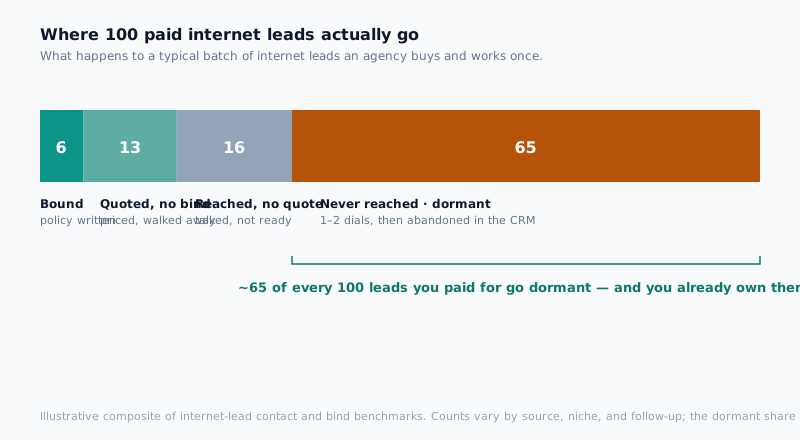
The won policies on the left are the ones every agency counts. The problem is everything to the right. Around two-thirds of a batch you paid full price for never gets a real conversation before it goes quiet. Those leads do not disappear — they accumulate, batch after batch, month after month, into the dormant database nobody has time to re-dial.
The reactivation math is almost embarrassing
Compare two ways to add conversations next month.
Buy fresh. You pay the vendor per lead, then pay a producer to dial it — and you are competing with three other agencies who bought the same lead, where the first 5 minutes decide who binds. Real cost per live conversation is the lead price plus the labor plus the losses to faster competitors.
Reactivate what you own. The lead price is already paid. There is no race against other agencies, because the prospect is yours and nobody else is dialing this list. The only new cost is the outreach. If even a small slice of a few thousand dormant records is back in market, you have manufactured conversations your producers would otherwise have paid to buy.
This is a close cousin of the aged-lead math, with one big difference: aged leads are someone else's castoffs you buy at a discount, while these are your own, bought at full price and already in your system. The discount on your dormant leads is 100 percent.
So why doesn't every agency do this?
For the same reason most leads go dormant in the first place. It is a volume job, and humans do not scale to it.
Asking a producer to re-dial a 4,000-record database is a non-starter. They are working this week's fresh leads, fielding inbound calls, and servicing existing clients. The reactivation list is important but never urgent, so it never happens. The few agencies that try usually mail a postcard or blast an email, get a 1 percent response, and conclude reactivation does not work. Email and mail are not the problem — they are just the only channels a busy team can run at that volume. The channel that actually re-engages a stalled insurance prospect is a phone call, and a phone call is exactly what nobody has the hours to make at scale.
That mismatch — high-value, low-urgency, impossible to staff — is the same shape as speed-to-lead and after-hours coverage. It is work that only gets done if it is automated.
Where Entrovox fits
Reactivating a database is one of the clearest things an AI voice agent does that a human team realistically cannot. Entrovox was built for exactly this kind of mechanical, high-volume outbound work.
- It calls the whole list, not the top of it. Point Entrovox at your dormant segment and it works every record on a schedule — not the 50 a producer gets to before the day fills up. The size of the database stops being the constraint.
- It qualifies before a human is involved. The AI confirms who is actually back in market — shopping again, unhappy with their current carrier, coming up on renewal — and warm-transfers only those live, interested prospects to a producer, with a one-page context card on screen. Your team spends its time on the conversations worth having, not on dialing voicemail across a four-thousand-row list.
- Consent and timing are enforced on every call. Old records are where stale consent and missed opt-outs hide. Entrovox scrubs against current DNC and revocation data in real time and honors the 8am-to-9pm local window automatically, so a reactivation push stays inside the lines — more in our TCPA guide.
- The calls actually get answered. Branded caller ID, STIR/SHAKEN attestation, and number rotation keep dials from landing as "Spam Likely", which matters even more on a cold list where the prospect does not recognize you.
- It runs on a cadence, at the right hours. Reactivation is not one call, it is a sequence — paced to the windows when people actually pick up and persistent past the one or two dials a human gives up after.
You already paid to fill that database. Entrovox is what finally works it.
What to do this week
You do not need a new system to find the opportunity — you need a number.
- Size the pile. Filter your CRM for leads with no contact in 90-plus days. Whatever that count is, multiply it by what you paid per lead. That is the acquisition spend currently sitting idle.
- Find the warmest slice first. Pull two segments before anything else: quotes that never bound, and anyone tagged "follow up later" or with an X-date in the next 90 days. These are your highest-intent dormant records and the obvious place to start — and they tee up the cross-sell and rounding you have been meaning to get to.
- Scrub before you dial. Run the list against current DNC and revocation data. Reactivation is legal when consent and timing are clean; old lists are exactly where that goes stale.
The leads are already yours. The only real question is whether anyone is going to call them.
Reactivating a dormant book is the same outbound job pointed at records you already paid for. See AI voice agent for insurance agencies.
Want to see Entrovox reactivate a slice of your own dormant database — qualification, warm transfer, and the producer's context card included? Book a 20-minute demo and we will run a live test on a list you already own.