The Best Time of Day to Call Insurance Leads (2026): An Hour-by-Hour Guide
Connect rates swing by hour and day: 4 to 6pm beats lunchtime by 114%, and Wednesday and Thursday beat the worst day by half. Here is the hour-by-hour data for calling insurance leads in 2026.
The number most agencies never look at
Ask an agency owner what their connect rate is and you will usually get a shrug or a guess. Ask what their connect rate is at 1pm versus 4:30pm and you get a blank stare. That second number is where a surprising amount of wasted lead spend hides.
Whether a prospect picks up an unknown number is not random. It moves in a predictable daily rhythm, and the swing between the best and worst hours is large enough to change how many live conversations your producers get from the exact same list of leads. You already paid for those leads. Calling them at the wrong hour is the cheapest mistake to fix on this entire list.
What the data actually says
The most-cited source here is the InsideSales.com/MIT Lead Response Management Study, which analyzed three years of data across six companies, more than 15,000 web leads, and over 100,000 call attempts. Two findings matter for scheduling your dials.
Best time of day. The late afternoon, 4 to 6pm, was the strongest window for making contact, beating the worst block (11am to noon) by about 114 percent. For qualifying the people you reach, the early morning held up best: 8 to 9am and 4 to 5pm beat the worst hour, 1 to 2pm, by about 164 percent.
Best day of week. Wednesday and Thursday won on both measures, beating the worst day by about 49.7 percent for contact and about 24.9 percent for qualifying. Monday and Tuesday lag for reaching people; Friday is the weakest day for qualifying the ones you do reach.
Later research points the same direction. Gong's analysis of roughly 100,000 connected B2B calls found connect rates peaked in the late morning and again at 4 to 5pm. CallHippo's review of tens of thousands of outbound calls landed on 4 to 5pm as the top hour and Wednesday and Thursday as the top days. Different datasets, same shape.
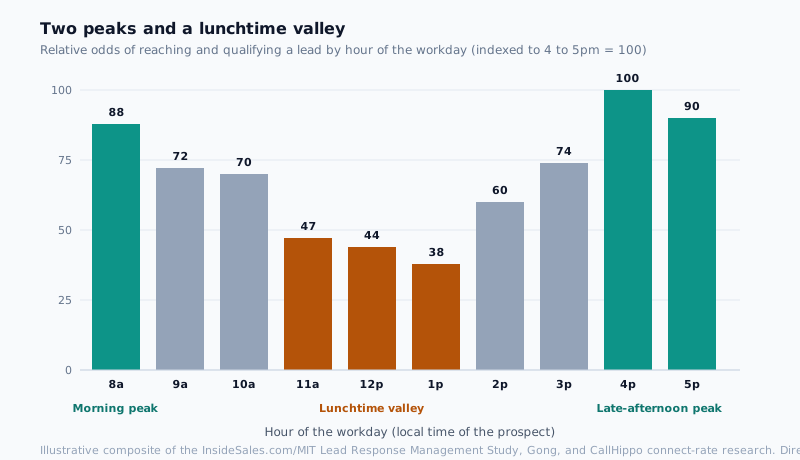
The picture is two peaks and a valley. People answer when the workday is starting and when it is winding down. They do not answer during the heads-down middle of the day or over lunch, when an unknown number is just an interruption.
A few honest caveats
Three things to keep this from turning into superstition.
First, these are general sales studies, blending B2B and consumer calling. The shape transfers well to personal-lines prospects (people are busy mid-day and freer at the edges), but treat the exact percentages as directional, not as a law of physics for P&C.
Second, "local time" means the prospect's clock, not yours. A 4:30pm call from a Florida agency to a lead in California lands at 1:30pm, straight into the dead zone. If you sell across time zones, the right window is a moving target per lead.
Third, the calling-window rules still apply. The TCPA limits outbound calls to 8am to 9pm in the prospect's local time, and some states are tighter. The high-connect afternoon window sits comfortably inside that, but the morning push and any cross-country dialing need to respect local time. We cover this in detail in our TCPA compliance guide.
Where this fits with "call instantly"
If you have read our speed-to-lead post, you might think this contradicts it. It does not. They govern different calls.
Speed owns the first touch. When a fresh lead arrives, you call it now, whatever the clock says, because a lead worked within five minutes is roughly 21 times more likely to qualify than one called at 30 minutes. A new lead at 1:15pm is still a call-right-now lead, lunchtime or not, because that same prospect is being sold to several agencies at once and the first to reach them usually wins.
Time-of-day owns the follow-up. Most leads do not answer the first call. As we covered in the 6-dial rule, it takes about six attempts to work a lead properly, and most agencies quit after one or two. Those redials are where time-of-day pays off: instead of firing them off whenever a producer remembers, you place them into that lead's 4 to 6pm and 8 to 9am windows. Same six dials, materially more pickups.
So the real playbook is not "call at 4pm." It is: first touch instantly, every redial timed. Doing both, for every lead, is where it stops being a human-schedulable problem.
Why you can't run this schedule by hand
Picture the actual logistics. Every new lead needs an instant first call. Every non-connect needs five more attempts, each dropped into a high-connect window, in the lead's time zone, ideally on a Wednesday or Thursday, without breaking the local 8am-to-9pm rule. Now multiply that across hundreds or thousands of leads a month, all at different points in their cadence at once.
No producer can hold that schedule in their head, and no whiteboard survives it. What actually happens is that producers call when they have a gap between other work, which clusters dials into late morning and early afternoon, the exact hours the data says are worst. The good window arrives at 4pm, right when the team is wrapping up and stops dialing. The schedule that would lift your connect rate is the one nobody has time to run.
Where Entrovox fits
This is squarely the kind of work software should own: mechanical, time-sensitive, impossible to staff perfectly. Entrovox runs the whole dialing schedule so your producers only handle live conversations.
- Instant first call, day or night. The moment a lead lands from any vendor or web form, an Entrovox AI voice agent calls within seconds, so you never trade speed away for timing. Off-hours leads that used to sit until morning get worked immediately, the gap we break down in the after-hours lead problem.
- Redials scheduled into the high-connect windows. Every follow-up in the multi-touch cadence is placed into that lead's strong hours, in the lead's own time zone, automatically. The 4 to 6pm peak gets hit for every lead, not just the ones a producer got to before going home.
- The calling window is enforced, not remembered. Local 8am-to-9pm limits, state overlays, and real-time DNC and revocation scrubbing apply on every call, so optimizing for connect rate never drifts into a compliance problem.
- Branded caller ID so the good hour isn't wasted. Calling at 4:30pm only helps if the phone doesn't read "Spam Likely." Every dial uses branded caller ID and STIR/SHAKEN attestation with number rotation, the fix from our spam-likely post.
- A warm human handoff. When a lead answers and qualifies, the AI warm-transfers the live call to a producer with a one-page context card on screen, so producer time goes to selling in the peak window, not to dialing through the dead one.
The economics are the same as everything else we write about: you already bought the leads. Working each one at the hour it is most likely to answer, across every time zone, without adding a single seat, simply converts more of the spend you already committed.
What to do this week
You do not need software to start. Pull 90 days of outbound call logs and tag each attempt by the hour and weekday it went out, then chart your connect rate against it. Two things almost always jump out: most of your dials cluster in the late-morning and lunchtime dead zone, and your 4-to-6pm window is underused because that's when the team is winding down.
That single chart usually makes the case on its own. Fixing it by hand is hard; fixing it by moving the dialing schedule off your producers' plates is the point.
Calling at the right hour still sits inside the same outbound job: AI voice agent for insurance agencies.
Want to see instant first calls plus time-optimized redials run on your own leads, qualification and warm transfer included? Book a 20-minute demo and we'll run a live test.