New in Entrovox: Your AI Can Now Call Your Book of Business, Not Just Your Leads
Point an AI voice agent at your book and it calls auto-only customers to pitch home. Plus branded caller ID, a warmer voice, and callbacks that keep their promise.
Most of what shipped this month was the AI getting better at the job it already had. This one is a new job.
Until now an Entrovox AI voice agent had exactly one purpose: call a new lead, qualify it, and warm-transfer the good ones to a licensed agent. That is the hard part of a growing agency's day, and it is where we started. But it is not where the cheapest premium in your business lives. That lives in the book you already own — the auto-only customers who have never been asked about their home, sitting in a CRM nobody has time to work.
So the AI can now call them.
Here's everything that shipped, at a glance:
- A cross-sell AI — point an AI at a CSV of your book and it pitches the line each customer does not own yet.
- Branded caller ID — opt a number in and your agency can render as a name and logo instead of an unknown number.
- A warmer voice, and three new ones — Expressive mode per AI, plus Jacqueline, Skylar and Grant.
- Spanish that sounds Spanish — the engine now follows the words being spoken, not a guess about the lead.
- Callbacks that keep their promise — a booked callback survives a paused source, and now a deleted one.
- CRM-aware dialing — the AI stops calling records your own team has already moved on.
New: an AI that calls your book, not just your leads
When you create an AI voice agent, you now pick what it is for.
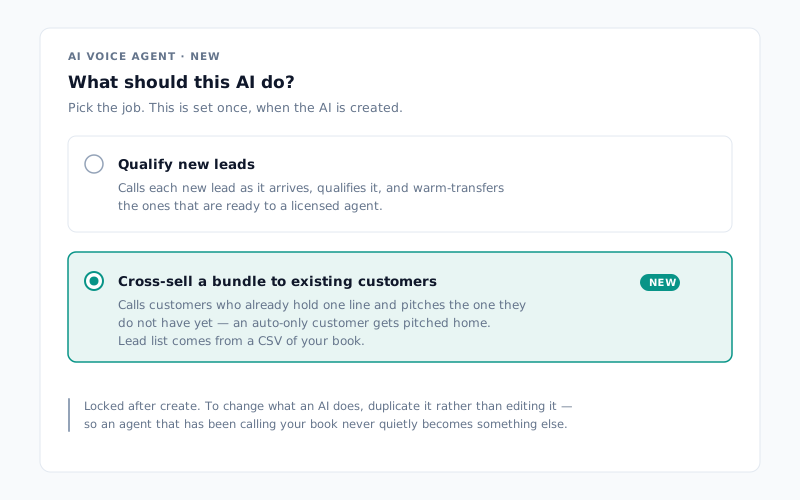
Qualify new leads is everything Entrovox already did, unchanged. Cross-sell a bundle to existing customers is the new one: the AI calls people who are already yours, opens on that footing, and pitches the line they are missing.
It is a genuinely different call, and the whole script knows it. The opening does not introduce a stranger to a stranger — it opens with an existing relationship. The objection handling is written for bundle objections, not shopping objections. And the AI is talking to a customer, not a lead, which changes both the tone and the consent basis for the call.
One deliberate constraint: the objective is locked once the AI is created. If you want to change an AI's job, you duplicate it. An AI that has been calling your book under one script should never quietly turn into something else under the same name.
Your CSV decides what gets pitched
A cross-sell campaign runs from a CSV of your book rather than a live lead feed, and each row carries the line that customer already owns.
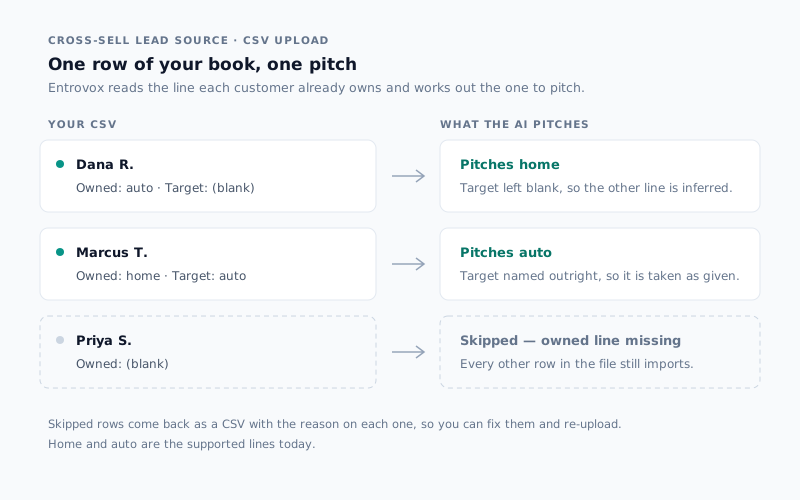
- Owned is required, and Entrovox reads a wide range of column names for it — current policy, existing coverage, has policy and several more all work, so you can usually export from your CRM and upload it as-is.
- Target is optional. Leave it out and Entrovox infers the other line: owned auto becomes a home pitch.
- Home and auto are the supported lines today.
The part that matters when you upload ten thousand rows at 6pm: a bad row is skipped, not fatal. A record with no owned line, or with the same line in both columns, drops out with a reason attached while the rest of the file imports. You get the skipped rows back as a CSV listing the row, the phone, and exactly why it was left out, so you can fix them and re-upload rather than re-cutting the whole export.
New: branded caller ID on your outbound calls
The oldest problem in outbound calling is that a good call never gets answered because the handset says nothing useful about who is ringing.
Each of your outbound numbers now has a Show logo on outbound calls setting. Turn it on and Entrovox runs call authentication for that number, so on carriers and handsets that support branded calling your agency can render with a name and a logo instead of an unfamiliar area code.
Two details worth knowing. It is off by default and set per number, so you can brand the line your licensed agents transfer from without branding everything else. And enrollment in the branding program itself is handled per agency — ask us and we will get your org set up.
We also started screening new numbers for reputation before they are bought, so a number does not arrive already carrying somebody else's history. If you want the background on why numbers get flagged in the first place, we wrote that up in why your outbound calls get flagged as spam.
New: a warmer voice, and three new voices
Each AI now has an Expressive setting. With it on, the voice carries more of the shape of the sentence — emphasis, pacing, the small lifts and drops that make a sentence sound meant rather than read.
Three new voices arrived alongside it: Jacqueline, Skylar and Grant. They replace two older voices that could not run on the newer speech path, and any AI still on one of those keeps working exactly as before.
A couple of honest caveats. Expressive only applies to certain voices, and the console will tell you when the voice you picked is not one of them rather than letting you turn on a setting that quietly does nothing. And on a Spanish-capable AI, the bilingual behavior below takes precedence. If you want the wider argument about how close this gets, we keep it up to date in do AI voice agents actually sound human.
New: Spanish calls that sound Spanish
This one is worth explaining properly, because the symptom was subtle and the fix changed a principle.
A bilingual call had its language decided in two places: the model choosing which words to write, and the speech engine choosing which language to pronounce them in. Those two could disagree — and when they did, the lead heard Spanish words spoken with an English accent.
It fired almost exclusively on the calls where it hurt most. Spanish-speaking leads answer with a single word — "¿Bueno?", "¿Aló?" — and a one-word answer was not enough to flip the speech engine, while it was plenty for the model to switch. So the first Spanish sentence of the call, the one that decides whether the person stays on the line, was frequently the mispronounced one.
The rule now is simply: the language of the audio is a property of the words being spoken. Every synthesized sentence is classified from its own text at the last moment before it is voiced, and Entrovox routes between two speech engines rather than trying to re-tune one. There is no longer a second opinion to disagree with.
If you run a bilingual book, Spanish-speaking insurance leads covers how much of the market this is.
New: callbacks that keep their promise
When the AI tells someone "I'll have a licensed agent call you Tuesday at one", that is a promise your agency made. Two ways it could quietly go unkept are now closed.
A paused lead source no longer swallows a booked callback. Pausing a source is how you stop new prospecting dials — it was never meant to cancel a commitment already made to someone. Callbacks now fire through a pause.
A deleted lead source no longer takes its callbacks with it. Everything a callback needs to dial is copied aside when the callback is booked, so the promise outlives the list it came from. You can now delete a finished source without wondering what you just cancelled.
And you can see all of it: the Upcoming callbacks section on your Calls page lists what is scheduled, with a plain Cancel on each one. Cancel means cancel — it does not add anyone to your do-not-call list as a side effect, which is a different decision that deserves a different button.
New: the AI checks your CRM before it dials
If your Ricochet360 account is connected, the AI now reads a customer's live CRM status before dialing and only calls records that are still genuinely workable.
The practical effect is the one you would want: when one of your licensed agents sells a policy, or moves a record down the pipeline, the AI stops calling it — without you having to remember to pull that person out of a campaign.
Where the CRM lookup itself fails, Entrovox errs toward dialing and raises an alert to us. A CRM hiccup should not silently stop your campaign; we would rather make the call and know about the problem.
Where this fits with everything else
- It is the cheapest premium you have. Cross-selling an existing customer skips acquisition cost entirely — the economics are in renewal and retention calls.
- It pairs with the after-hours lane. New leads at 8pm, your book during the quiet parts of the day. The evening half is in the after-hours calling lane.
- Branded caller ID is the other half of connect rate. Speed gets you dialing first; branding gets you answered — see outbound calls flagged as spam.
- The handoff is still a licensed agent. A cross-sell call that goes well ends the same way a qualification call does; we compared the options in live transfer vs. callback.
What to do this week
If you want to try the cross-sell lane, the shortest useful test is one segment, not your whole book:
- Export your auto-only customers from your CRM — phone, name, and whatever column says what they own.
- Create a new AI voice agent and pick Cross-sell a bundle to existing customers.
- Upload the CSV as the lead source, check the import summary for skipped rows, and let it run a week.
Then look at one number: how many of those customers reached a real conversation with a licensed agent about a line they had never been asked about. Whatever that number is, it was zero last month.
Cross-selling your book is one job on the AI voice agent for insurance agencies scorecard.
Want help pointing one at your book? Book a 20-minute demo and we'll cut the first segment with you.