AI Did Not Change the Strategy. It Changed the Price.
Field notes from Craig Pretzinger and Jason Feltman of The Insurance Dudes at CCAC 2026, and the lead-buying math that should change how you staff your phones.
Field notes from Craig Pretzinger and Jason Feltman's session at CCAC 2026, plus the math behind it.
I sat in on Craig Pretzinger and Jason Feltman's session at CCAC in Las Vegas this week. They run The Insurance Dudes, the podcast a lot of P&C agency owners already listen to on the drive in, and they opened with one line on the screen:
AI didn't change the strategy. It changed the price.
Then they spent the session proving it with their own data. This post is my summary of their talk. The numbers, the frameworks, and the good lines are all theirs. If any of it lands, go listen to them directly. Links are at the bottom.
Key takeaways
- A cheap lead is usually the expensive lead. Judge cost per sale, not cost per lead.
- It takes roughly 430 dialing attempts to make one sale. That is a capacity problem, not a motivation problem.
- Calling and closing are two different jobs. Nobody maximizes both.
- A missed sales number tells you that something broke. Only the funnel tells you where.
- Once you know lifetime value, "how much does this cost" stops being the right question.
They are not guessing
Craig and Jason are not consultants who read a study. They put their receipts on the second slide:
- 119,165,467 dials placed on well over a million leads
- For 600+ agencies
- 900 podcast episodes with owners actually running books of business
- Tens of millions sold out of their own agencies
Nearly everything below comes out of that dataset.
Stop judging the lead
The first thing they took apart is the way most owners shop for leads.
Don't judge the lead. Judge the economics of what happens to the lead.
Two lead sources, same agency, same producers:
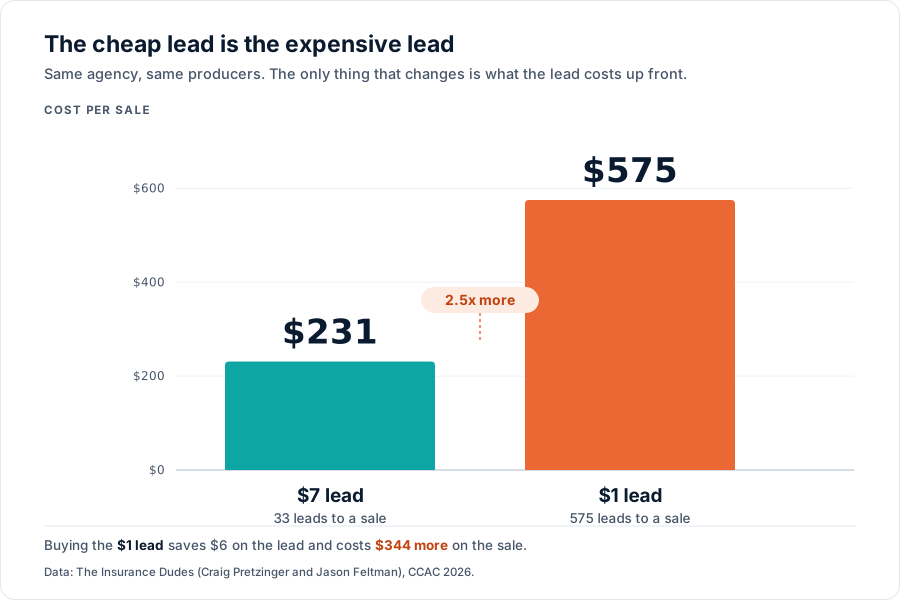
The $7 lead takes 33 leads to make a sale. That is $231 per sale.
The $1 lead takes 575 leads to make a sale. That is $575 per sale.
You saved six dollars on the lead and paid $344 more for the customer. The cheap inventory was 2.5 times more expensive where it counted.
Their next slide is the one that got the room quiet:
Maybe your leads don't suck.
Leads don't answer more than 80% of the time. You're paying a licensed producer to listen to ringing. That's activation. And it's a different job.
The 430
Here is the arithmetic they put on screen, and I have checked it:
- Roughly 13 dials per lead
- About 3% of leads turn into a sale, so about 33 leads per sale
- 13 x 33 = roughly 430 dialing attempts per sale
Then the question they left hanging over the room:
Who in your agency is making those 430 dials?
Because whoever it is also has to quote, present, follow up, handle objections, close, and bind. And then start the next 430.
That's not a motivation problem. That's a capacity problem.
That distinction is the whole talk. Most owners respond to a soft month by pushing harder on people who are already out of hours. The hours were the constraint, not the effort.
Attempts compound, and they compound hard
This was the chart of the session:
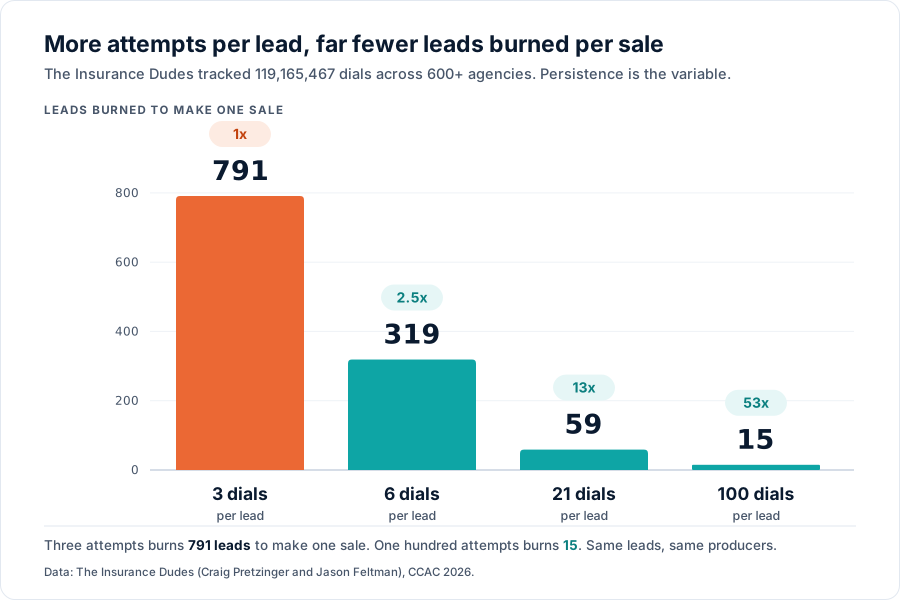
At three attempts per lead, it takes 791 leads to make a sale. At one hundred attempts, it takes 15.
Same lead spend. Same producers. Fifty-three times the yield, from persistence alone.
One honest note. These absolute figures do not line up cleanly against the 33-leads-per-sale number above, and they did not walk through why. Treat the shape of the curve as the finding rather than the individual bars, and the shape is dramatic.
Nobody sits in a chair and makes 100 attempts on a single lead. That is precisely their point. The ceiling is not discipline. It is a human being with a finite number of hours.
Callers activate. Producers convert.
Their fix is organizational before it is technological. Here is how they size a full day in each seat:
| Caller | Producer | |
|---|---|---|
| A full day | 600+ dials | 8 to 10 households quoted, 4 to 6 hours of talk time |
Nobody maximizes both. Two Jobs, Two Buckets.
And then the slide I keep thinking about:
We didn't find A players. We changed what our sales people spent the day doing.
Acquisition gave them opportunities. Activation turned those into conversations. Hundreds of dials came off their plate.
Activity tripled. Sales tripled. Same salespeople.
No new hires. Same people in the same seats. They took the activation work off the closers.
The funnel tells you where
Most agencies manage one number: sales. Craig and Jason argue that is the last place to look, not the first.
Sales tell you THAT you have a problem. The funnel tells you WHERE.
Sales are the end of the process. Find where the number broke.
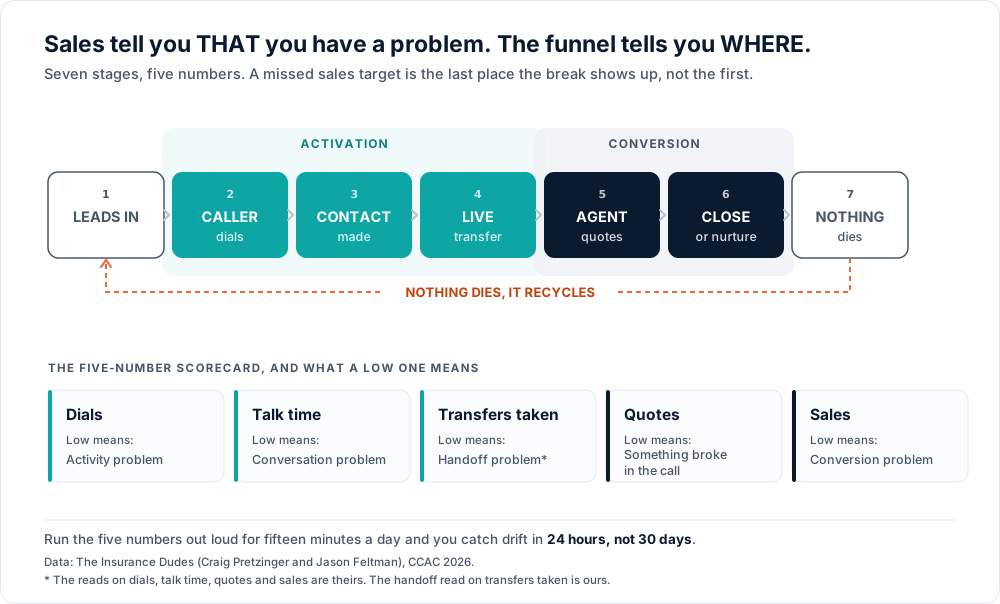
Five numbers per producer, every day. Dials. Talk time. Transfers taken. Quotes. Sales. Their read on each:
- Low dials is an activity problem
- Low talk time is a conversation problem
- Low quotes means something broke inside the call
- Low sales is a conversion problem
The 5 number scorecard tells you more about a producer's day than watching them for eight hours.
They run it as a fifteen-minute daily huddle: scorecard out loud, target versus actual as a yes or no, a hot seat on what is stuck and what changes today, recognition, then today's target. The promise is that you catch drift in 24 hours instead of 30 days.
It isn't one more thing to manage. It's the thing that keeps everything else managed.
One more piece for the call itself: 1 opener, 5 stories, 10 objections. That is the whole script surface. Reps against a fixed set, not improvisation.
Put on the investor hat
The back half of the talk was about the other side of the ledger.
We measure the wrong side of the transaction.
Owners are excellent at knowing what goes in. Cost of the lead. Cost of the caller. Cost of the producer. Cost of the technology. Then they compare one month of spend against one month of commission, which is the wrong comparison, because you do not buy that customer again next year. They renew, and renew, and renew.
Step one, turn retention into renewals. At 80% retention: 100% - 80% = 20%, and 80 / 20 = 4 renewals.
Step two, price one sold lead. Take $1,500 in written premium at 10% new business and 10% renewal commission:
$150 today, plus four renewals at $150, equals $750 in lifetime value.
That shortcut is not a rounding trick. They showed it beside the long way, a year-by-year schedule that decays each renewal by the 80% retention rate ($150, $120, $96, $77, $61, and on out to a penny), and both columns land on $750.
Scale it up and a month at $50,000 in written premium is worth $25,000 in lifetime value.
And they were careful to say this understates it. Additional vehicles. The home. An umbrella. Other policies. Their kids eventually become customers. Referrals. And the one they flagged on the slide as the big one: carrier bonuses or incentives.
Cost was never the question.
Before LTV: "How much does this cost?" After LTV: "What does this return?"
And those are two completely different questions.
Their decision rule fits on one line. A dollar in and fifty cents out, stop. A dollar in and a dollar out, why bother. A dollar in and three dollars out, pour gas.
Where should the next $25,000 go?
This was the closing argument, and it is the slide I would put in front of any owner sitting on cash.
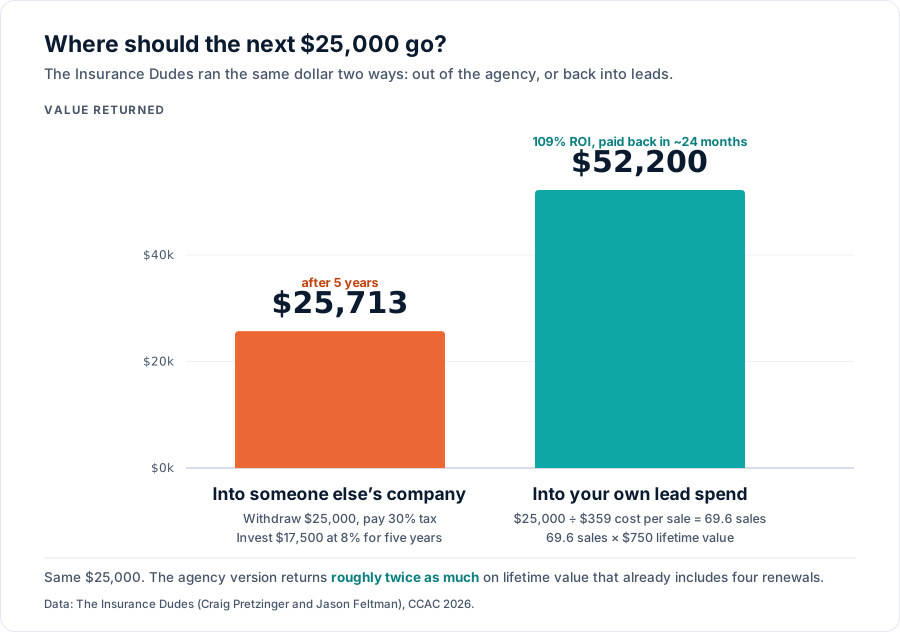
Out of the business: withdraw $25,000, pay 30% in tax, and you have $17,500 to invest. Five years at 8% gets you to $25,713. Then pay capital gains on the growth.
Into the business: $25,000 of lead spend at a $359 cost per sale buys 69.6 sales. At $750 of lifetime value each, that is $52,200, returned in roughly 24 months, a 109% ROI.
I ran both columns and the arithmetic holds. One honest caveat they did not raise, and I will: $52,200 is already 69.6 sales at $750 of lifetime value, and that $750 already includes the first $150 plus four renewals. It is gross commission arriving over about five years, while $25,713 is a liquid after-tax balance. They are not the same kind of dollar. Discount the commissions and net out the cost of servicing the book and the gap narrows. It does not close. The unmodeled upside they set aside is referrals, additional policies, and carrier bonuses, not another round of renewals.
Which is how they got to the last line worth quoting:
You can't out-work a renewal.
And, for anyone who has been sitting on this decision for two quarters:
Scared money doesn't renew. The math already told you. The fear just talks louder.
Their three numbers
If you take one thing from the session, take these:
- Cost per sale
- Annual retention
- Lifetime value
Know those three and every spending decision in the agency answers itself.
They closed on this:
When your producers win, your agency wins. When your agency wins without you, you win.
And the line running along the bottom of their last slide:
Build the process. Build the producer. Build the business. Buy back your life.
Where we fit
I will be direct about why this talk matters to us, and then I will get out of the way.
Craig and Jason named the category we work in. Activation is a different job from conversion. They proved it across 119 million dials, and they solve it by putting dedicated callers in front of the producers. We solve the same job with an AI voice agent.
Three things change when the caller is software:
- It does not get tired at dial 400, and attempt 100 costs the same as attempt 3
- It can work the 5pm to 9pm window, when leads actually answer, without anyone staying late
- It reaches a fresh lead in under 60 seconds instead of the next morning
And three of their five scorecard numbers are ours to own. Dials, talk time, and transfers taken are what an activation layer is accountable for. Quotes and sales stay with your licensed producers, where they belong.
Watch transfers taken hardest. A warm transfer that nobody picks up is a lead you paid for twice. We have seen that failure mode first-hand, and it is an agency-side staffing fix, not a software fix.
None of this replaces the producer. It replaces the ringing.
Go listen to them directly
This post is a summary. The Insurance Dudes put out the real thing, and most of it is free:
- The Insurance Dudes podcast, the long-running show for P&C agency owners: theidudes.com
- Million Dollar Agency, their book on scaling an agency. They were handing out free copies at the session
- A dial calculator that takes your premium goal and tells you the dials it actually requires
- Their site also lists TeleDudes and the TeleFunnel, and Agent Elite, their community for agency owners
Thank you to Craig Pretzinger and Jason Feltman for a session with actual numbers in it, and to CCAC for putting it on the schedule.
Charts above were rebuilt for readability. All underlying data is The Insurance Dudes', presented at CCAC 2026.
Want to hear what an activation layer sounds like? Call (206) 809-9586 and hear it call you back, or get a demo call and we will dial your own phone so you can judge it yourself.